

A visitor has spent ten minutes explaining what they need. Your website assistant has clarified the budget, the timeline and the awkward constraint that makes the request real. Then the visitor clicks “contact us” and lands on a form that asks the same questions again. That is not a handoff. It is a reset. AI conversation continuity is the small product decision that stops useful intent from evaporating between a chat, a form and a person.
Table of Contents
Continuity is not a chat log
Continuity does not mean silently keeping every word a visitor has ever typed. It does not mean dumping a transcript into a salesperson’s inbox and calling that personalisation. It means carrying forward the minimum useful context for the next agreed step.
For a business website, that context is usually smaller than teams expect: what the visitor is trying to achieve, the relevant product or service, any stated constraint, the preferred follow-up route and the permission to share it. A good assistant can turn that into a short handoff note a human can scan in seconds. The visitor should be able to see the same summary before it travels.
This matters because a website is increasingly the first sales conversation, not a brochure. meLink has previously argued that after-hours website coverage is a growth decision. Coverage is only half the job. If a promising conversation disappears at the moment a person is needed, the business has created availability without momentum.
AI conversation continuity needs a small packet
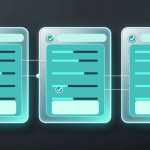
The useful unit is a continuation packet, not a transcript. Think of it as a compact record with five fields:
- Goal: what the visitor wants to get done.
- Constraint: budget, timing, location, technical requirement or concern that changes the answer.
- Current answer: what the assistant has already explained or proposed.
- Next step: the action the visitor chose: book, request a quote, receive a document or speak to someone.
- Permission: what may be passed on, to whom and by which channel.
That packet makes AI conversation continuity operational. It also gives the next owner a place to begin. A sales teammate does not have to pretend they have read a long chat. They can say, “I see you are comparing two options, need an answer before Friday, and asked for an email rather than a call. Is that still right?” That is a more credible opening than “How can I help?”
The packet should be editable, not sacred. Visitors change their minds. A staff member may discover that the assistant misunderstood a constraint. Treat the record as a proposed briefing, with a clear source and timestamp, rather than as truth that cannot be questioned.
Consent is part of the handoff
Continuity gets uncomfortable when it becomes invisible. The customer’s convenience cannot be an excuse to move personal or sensitive details into systems they did not expect. Privacy-respecting AI conversation continuity starts by making the boundary legible: what will be shared, why it is needed and how long it will be kept.
That is practical product design, not legal decoration. The NIST Privacy Framework frames privacy risk as something organisations manage through real processes, not just policies. On a website, a simple confirmation can do a lot: “I can send this summary to our team so they can follow up by email. Include my timeline and budget?” The visitor can approve, edit or decline.
Keep the principle narrow: pass what the next step needs, and no more. A delivery question does not require a full history of unrelated browsing. A booking request does not need every exploratory question. This is where data classification and retention rules matter, but the customer-facing test is simpler: would a reasonable visitor be surprised by what arrives in the next person’s view?
Design the human return path
A useful handoff is a return path, not an exit. The assistant should tell the visitor what happens next, who owns it and when they can expect a response. If the team cannot answer immediately, say so plainly. Recent work on AI status design makes the same point for pending work: a truthful state is better than an animated promise.
For operators, this means deciding where continuity stops. A request for a quote might create a labelled inbox item and a short summary. A complex support issue might create a case for a named specialist. A sensitive request might intentionally go no further until a person asks for consent. AI conversation continuity is not an argument for automating every transition. It is a way to make each transition deliberate.
The same discipline helps teams avoid the common “AI owns the customer” mistake. The assistant owns neither the relationship nor the final promise. It helps a visitor move without friction, and it gives the human team a better starting point. That is a healthier division of labour.
Measure restarts, not messages
Teams often count chats, leads or answered questions. Those are useful, but they can hide the failure that matters: how often did a serious visitor have to restate their goal after the assistant had already learned it?
Track a few simple signals: the share of qualified conversations that produce an approved continuation packet; the share that receive a human acknowledgement within the promised window; and the share where the visitor has to repeat a material detail. Review a small sample of handoffs every week. The goal is not perfect memory. It is fewer unnecessary restarts.
Accessibility offers a useful parallel. The W3C’s guidance on consistent identification asks digital services to use familiar cues consistently. Conversation handoffs deserve the same care: the visitor should recognise their own goal and understand the next route, even when the channel changes.
The best website assistants do not try to sound endlessly human. They do something more useful: they remember only what has been agreed, make that memory visible, and hand it to the right person without making the customer begin again. That is AI conversation continuity worth designing for.

Leave a Reply