
Most business websites have the same uncomfortable problem: they look open, but they are not really available.
A visitor lands on your site after dinner. They have a real question. They are interested enough to click around, compare options, maybe ask about pricing, availability, delivery, timelines, integrations, or whether you can solve their specific problem. Then they hit the same old wall: a contact form, an email address, or a phone number nobody is answering right now.
That is not a small detail. That is the moment the sale starts cooling down.
The website is no longer just a brochure
For years, a website could get away with being a polished brochure. Explain what you do, show a few services, add a contact page, job done.
That world is fading. People now expect websites to behave more like a helpful front desk. They want quick answers, clear next steps, and a sense that someone is paying attention. Not necessarily a human at 11:47pm, but something useful enough to keep the conversation alive.
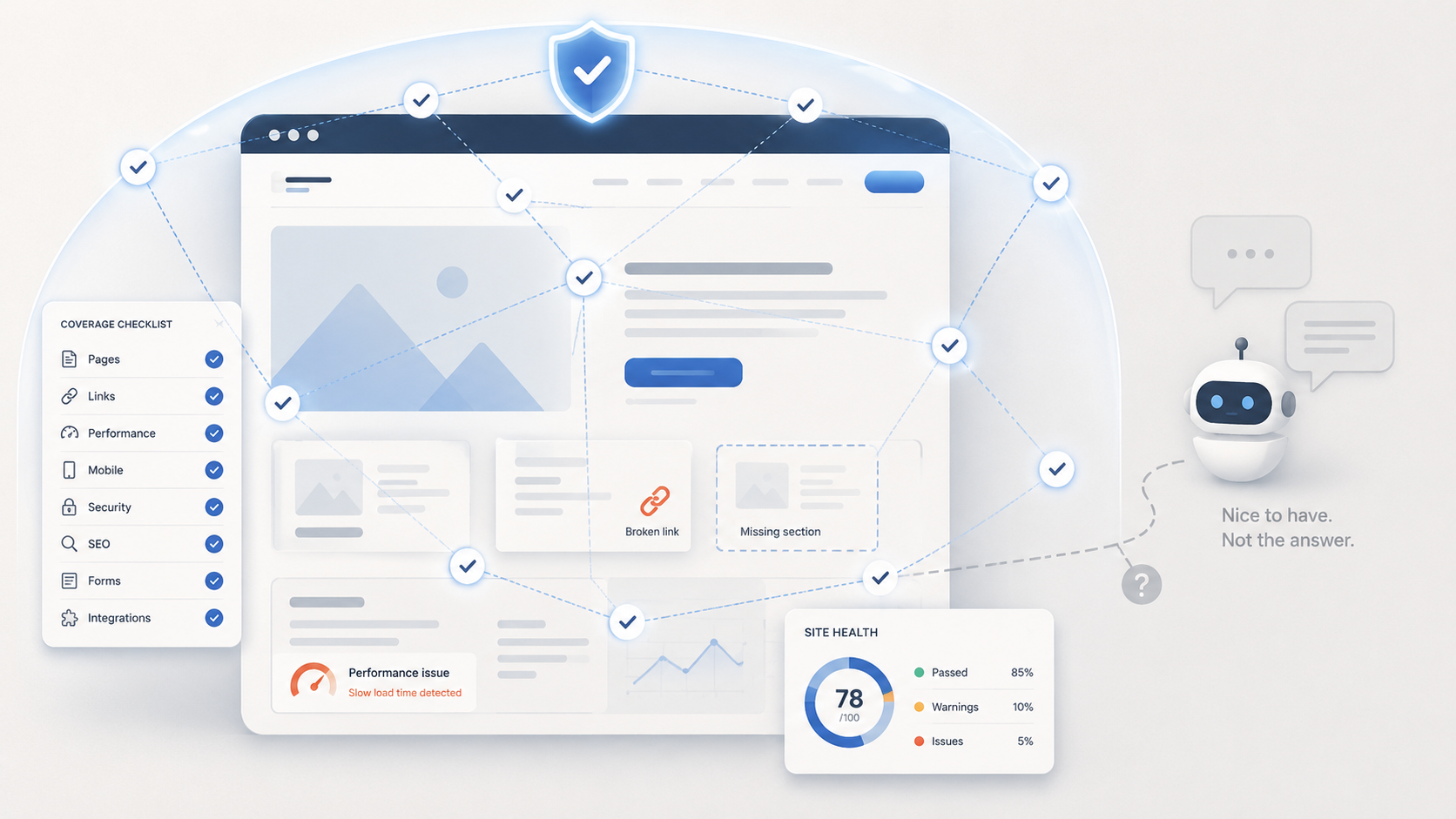
This is where many businesses make the wrong jump. They hear “AI” and think the answer is to bolt on a chatbot. But a chatbot, by itself, is not the goal. Coverage is the goal.
Coverage means the visitor is not left alone
Coverage is simple: when someone arrives with intent, your site can respond in a useful way.
- It can answer the obvious questions without making the visitor hunt.
- It can guide someone to the right product, service, page, or person.
- It can collect the details you actually need, not just dump another vague form submission into an inbox.
- It can alert the right person when a lead is worth attention.
- It can do all of this without pretending to be human or spraying your data everywhere.
That last point matters. The next wave of useful AI will not be won by the loudest bot. It will be won by tools that are grounded, respectful, and clear about what they can and cannot do.
The trust problem is bigger than the tech problem
Business owners are right to be cautious. A public-facing AI assistant can create risk if it is vague, overconfident, or disconnected from the real business. Nobody wants a tool inventing prices, promising impossible timelines, or giving customers the wrong answer with confidence.
So the question is not “can we add AI to the site?” The better question is:
Can we give the website a useful layer of assistance while keeping control of the business context?
That is the line meLink cares about. AI should not turn your website into a guessing machine. It should work from your knowledge, your pages, your services, your catalogue, your rules, and your preferred next steps.
A quiet website is expensive in ways you do not see
The painful part is that missed website conversations are mostly invisible. You usually do not get a report that says, “Three good visitors left because nobody answered their question.” You just see lower enquiries, slower growth, and the occasional person who says they nearly went somewhere else.
Small teams feel this the most. You are building the product, serving customers, handling admin, answering WhatsApps, sending quotes, and trying to keep the business moving. The website should be helping with that load. Too often, it just waits.
What good website AI should feel like
Good website AI should feel calm. It should be useful without being pushy. It should sound like the business, not like a generic demo. It should know when to answer, when to ask a better question, and when to hand over to a human.
Most importantly, it should respect the visitor. People do not want to be trapped in a gimmick. They want help. If the assistant can answer in seconds, great. If it needs to capture details and route the enquiry, also great. If it cannot help, it should say so plainly and point to the next best step.
This is why we are building meLink web
meLink web is our answer to the quiet website problem. It is not meant to replace the people behind the business. It is there to keep the conversation warm until the right person can step in.
The product is built around a few practical ideas: embed it quickly, ground it in the business, keep it on-brand, capture useful leads, and keep control where it belongs. Privacy and trust are not add-ons. They are part of the product shape.
Because the real opportunity is not “AI on every page.” The opportunity is a website that finally does more of the work it was supposed to do.
The thought worth sitting with
If your website is getting traffic but not starting enough conversations, the problem may not be the design, the copy, or the call-to-action button.
It may be that your visitor needed a little help in the moment — and the site stayed quiet.
That is a fixable problem.
You’ve got this.


Leave a Reply