
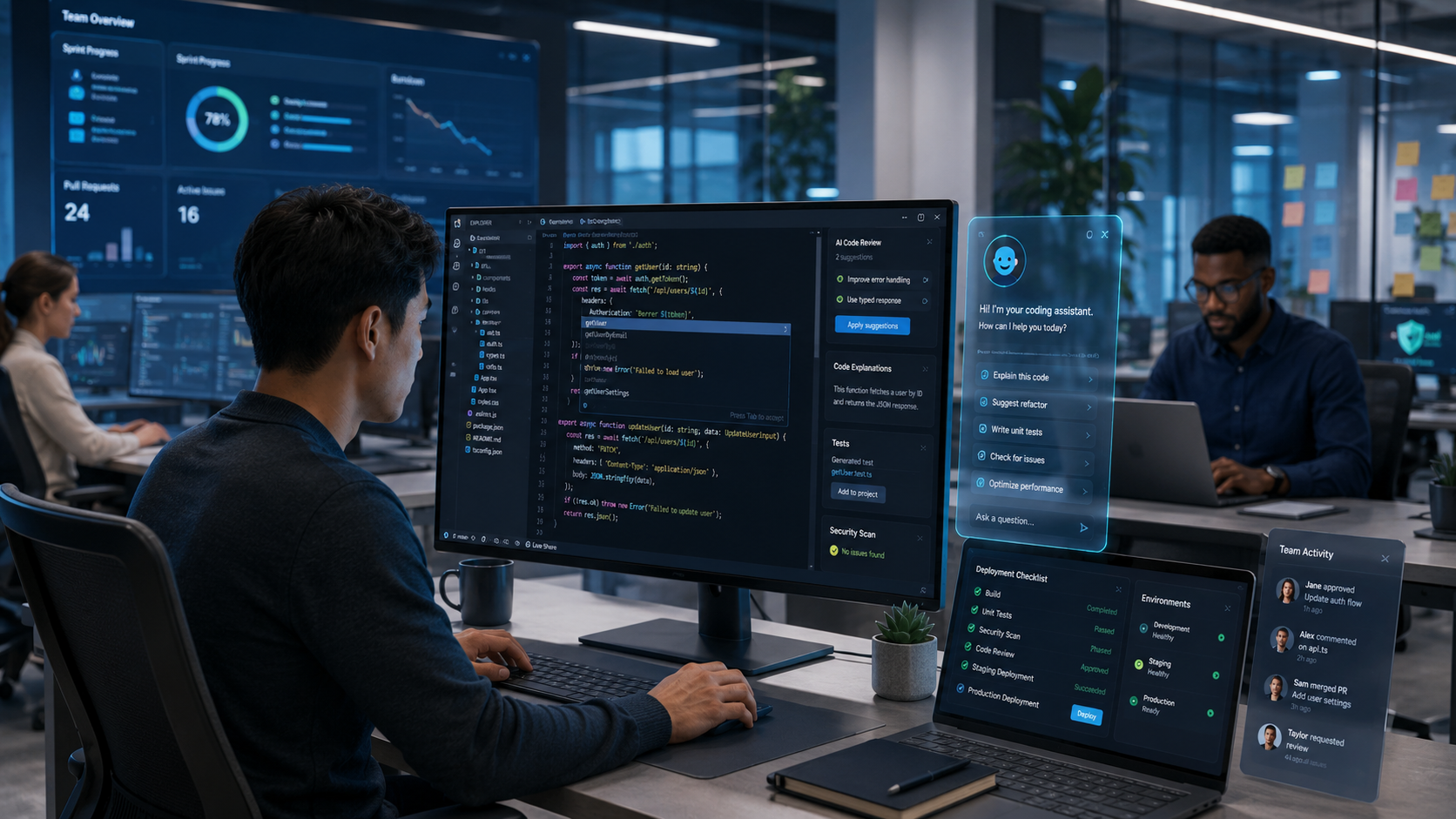
Microsoft’s in-house coding model, MAI-Code-1-Flash, is now generally available for GitHub Copilot Business and Copilot Enterprise. On its own, that sounds like a product-line update. In context, it is a useful signal: the AI coding market is moving from “which frontier model is smartest?” to “which model is fast, cheap enough, governable, and good enough to sit inside real work all day?”
That matters beyond developers. Coding agents are the early test bed for a much wider class of business agents: tools that read context, propose actions, edit important systems, and need human supervision without slowing everything down. If the enterprise AI layer is going to become practical, model choice has to become more operational and less theatrical.
The big signal
GitHub says MAI-Code-1-Flash is “purpose-built for coding” and optimized for GitHub Copilot, with fast, low-latency responses suited to “high-volume, iterative agentic coding workflows.” The important phrase is not just coding model. It is agentic workflows.
For the last two years, the frontier AI conversation has been dominated by model jumps: larger context windows, better reasoning scores, bigger multimodal demos, and headline benchmark wins. Those things still matter. But business adoption has a different bottleneck. A company using AI hundreds or thousands of times per day cares about latency, cost predictability, admin controls, auditability, model availability, and whether the assistant behaves consistently inside a managed workflow.
That is why Microsoft shipping its own coding model into Copilot Business and Enterprise is worth watching. It gives Microsoft and GitHub more control over the economics and product experience of AI-assisted software work. It also gives enterprise administrators another model policy to manage: GitHub notes that Copilot Business and Enterprise admins must enable the MAI-Code-1-Flash policy before users can access it, and that the model is billed under usage-based billing at provider list pricing.
In plain English: AI model selection is becoming an admin surface. That is a real shift. The next wave of practical AI will not be one universal model dropped into every task. It will be a portfolio of models routed by job type, risk, speed, privacy needs, and budget.
There is also a competitive subtext. Microsoft has relied heavily on OpenAI, but GitHub Copilot increasingly looks like a place where multiple models can compete under one workflow. The interesting question is not whether MAI-Code-1-Flash beats every general-purpose model at every task. It is whether Microsoft can make a fast specialist model feel better for the repetitive, high-frequency loops where developers spend much of their day: reading errors, making small changes, running tests, explaining code, and moving through review feedback.
For small teams and builders, that is the practical lesson. The best AI stack is rarely “the biggest model for everything.” It is the right model in the right lane, with clear escalation paths when the task becomes sensitive, ambiguous, or expensive.
Open-source watch
The open and open-adjacent ecosystem is moving in the same direction: less glamour, more deployment reality.
- NVIDIA’s Nemotron 3 Ultra NVFP4 checkpoint: NVIDIA published a technical walkthrough on creating the Nemotron 3 Ultra NVFP4 checkpoint with NVIDIA Model Optimizer. The headline claim is practical rather than cosmetic: the model shrinks from 1,121 GB in BF16 to 352.3 GB after NVFP4 quantization, and NVIDIA says the checkpoint can run across Hopper and Blackwell by adapting the weight format to the hardware. For anyone deploying local or private AI, the message is clear: serving efficiency is becoming as strategically important as raw model quality.
- Anthropic’s Economic Index adds hourly work patterns: Anthropic’s latest Economic Index report, “Cadences,” is not an open model release, but it is useful context for adoption. Anthropic says it changed its data pipeline to sample at a higher rate, allowing usage patterns down to the hourly level, and added a classifier for conversation outputs. The key builder takeaway is that AI use is becoming a work-rhythm problem, not just a tool-choice problem. Assistants need to fit the cadence of real jobs.
- Qualcomm and Hugging Face push edge-to-cloud AI: Qualcomm and Hugging Face announced an expanded relationship to advance open, developer-driven AI “from device to cloud,” according to the company announcement surfaced in Google News. The strategic direction is familiar but important: more models optimized for phones, PCs, edge devices, and private deployments. For privacy-respecting AI products, that is a tailwind.
What builders should take from this
The model market is splitting into layers. At the top, frontier labs still define what is possible. In the middle, product companies such as Microsoft and GitHub are packaging AI into managed workflows. Underneath, open and open-adjacent infrastructure is making deployment cheaper, faster, and more private.
That split is healthy. A website sales assistant, an internal operations agent, or a visual orchestration tool should not need the same model for every turn. A fast model can classify intent, retrieve context, draft a first response, or handle routine steps. A stronger model can be reserved for complex reasoning, sensitive exceptions, or high-value actions. A local model can handle private context where cloud calls are unnecessary or inappropriate.
This is also where governance stops being a compliance afterthought. GitHub’s admin policy requirement for MAI-Code-1-Flash is a small detail with a big implication: organizations will increasingly decide which models are allowed for which classes of work. That will affect procurement, security review, cost control, and user trust.
Investors should read this as a sign that the AI application layer is getting more disciplined. The winners may not be the teams with the flashiest demo. They may be the teams that understand model routing, permissions, observability, handoffs, and cost curves. Those are boring words, but they are what make AI usable every day.
The practical takeaway
MAI-Code-1-Flash coming to Copilot Business and Enterprise is not just another model in a dropdown. It is a sign that serious AI products are becoming systems: specialized models, admin controls, usage-based economics, and workflows built around repeated action.
For builders, the lesson is to design AI products like operations software, not like magic search boxes. Choose models by task. Keep humans in the right loops. Measure latency and cost as carefully as accuracy. Make privacy a product decision, not a paragraph in the terms of service.
The next useful AI assistant will not be impressive because it can answer one hard question in a demo. It will be useful because it can handle the hundred ordinary steps that make up a real workday, without surprising the people who depend on it.


Leave a Reply