
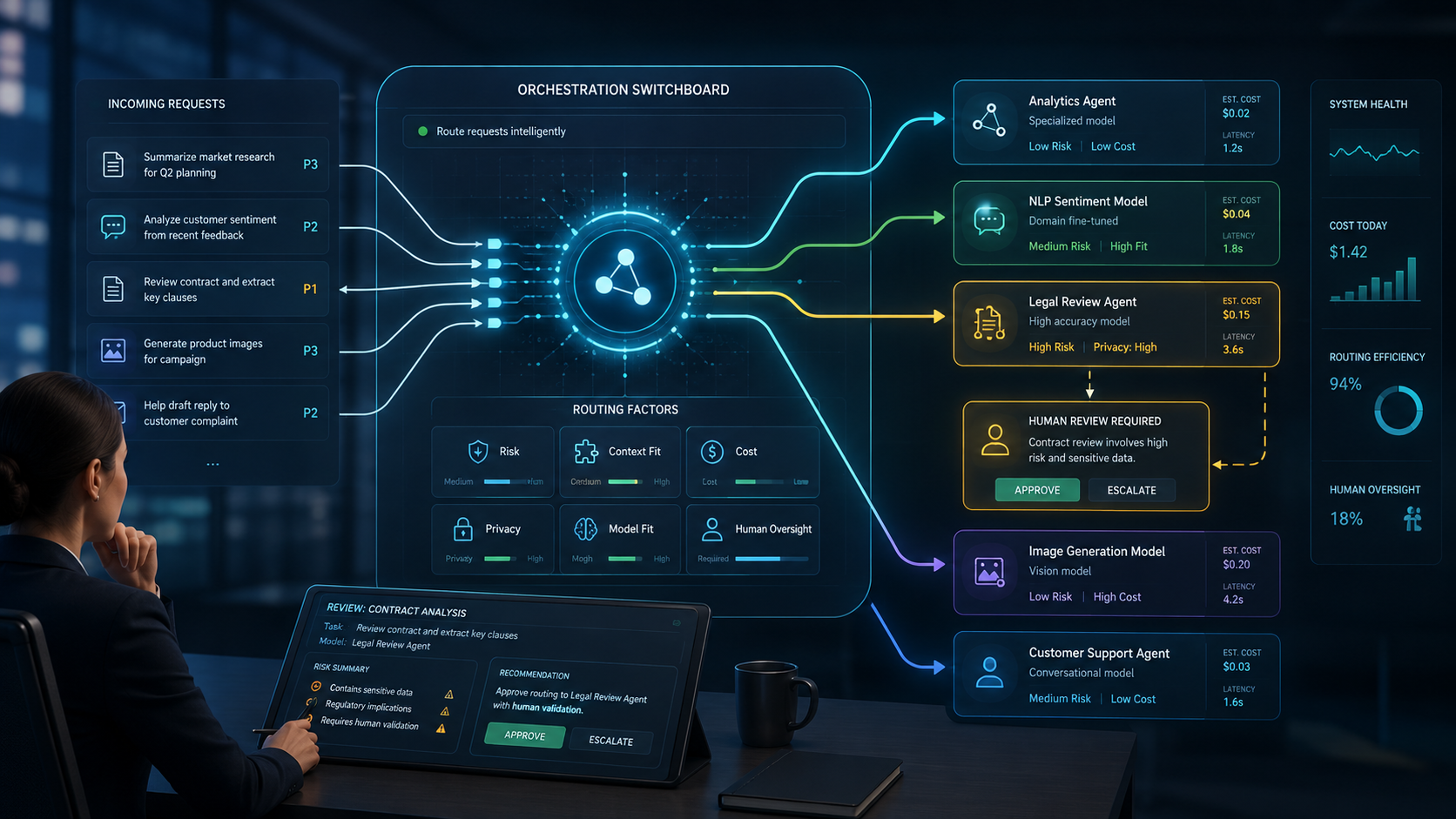
The next useful layer in business AI will not look like one giant assistant that knows everything and does everything.
It will look more like a switchboard.
That sounds less glamorous, which is probably why it deserves more attention. A switchboard does not try to be the smartest person in the company. It receives a signal, understands enough about the situation, and connects the work to the right place: a person, a tool, a workflow, a model, a memory, a queue, or a stop sign.
For small teams, this may be the difference between AI that feels impressive in a demo and AI that becomes part of the business.
The superbrain idea breaks down fast
A lot of AI adoption still starts with the superbrain fantasy: connect the assistant to every document, every customer record, every inbox, every product detail, every calendar, every note, and every tool. Then ask it anything. Then let it act.
The appeal is obvious. One interface. One assistant. One place to go. It feels clean.
But businesses are not one kind of work. They are a mix of different lanes with different rules. A sales question is not the same as a billing problem. A public website visitor is not the same as a logged-in customer. A draft reply is not the same as a refund. A product recommendation is not the same as a legal commitment. A low-risk summary is not the same as an action that changes a record.
When all of that flows into one undifferentiated assistant, teams end up fighting the wrong problem. They try to make the assistant universally wise, when what they really need is a better way to route work.
A switchboard asks a better first question
The first question should not be, “Which model can handle this?”
It should be, “What kind of situation is this?”
That one shift changes the design of the whole system. If the situation is low risk, the assistant can answer directly. If the question involves private information, it may need a narrower context window or a local model. If the user is close to making a buying decision, the system may need to qualify intent and prepare a human handoff. If the action is reversible, automation can go further. If the action is sensitive, the assistant should slow down and ask for approval.
None of this requires pretending AI is weak. It is the opposite. It treats AI as capable enough to deserve proper operating lanes.
The strongest AI systems will not simply answer. They will classify the moment, choose the right path, and make the handoff visible.
The routing layer is where strategy becomes product
Most AI strategy sounds abstract until it reaches the routing layer.
- If privacy matters, what data is allowed into which model?
- If cost matters, which tasks deserve the expensive model and which do not?
- If trust matters, which answers need citations, review, or a human owner?
- If customer experience matters, when should the assistant continue and when should it bring in a person?
- If speed matters, which workflows can run automatically and which should wait?
These are not policy questions in the abstract. They are product decisions. They decide what a customer experiences, what an employee trusts, what a founder can audit, and what an investor can believe will scale.
This is also where local-first and cloud AI stop being ideological camps and become practical tools. Some work belongs close to the user because it is sensitive, repetitive, or context-heavy. Some work belongs in the cloud because it needs the strongest reasoning available, shared infrastructure, or a specialist model. Many real systems will use both.
The point is not to pick a permanent side. The point is to build a switchboard that knows when each side is appropriate.
Small teams need orchestration before autonomy
Autonomy gets the attention. Orchestration does the work.
For an operator, the useful question is rarely, “Can the agent complete the entire process alone?” It is usually, “Can the system move the right pieces of work to the right places without losing control?”
That might mean a website assistant answers common product questions, then routes a serious buyer into a sales note with the context preserved. It might mean an internal assistant drafts a customer reply, but sends anything involving price, cancellation, or legal language to review. It might mean a visual workflow where research, summarisation, decision, approval, and execution are separate blocks instead of one mysterious prompt.
This is the difference between “the AI did a thing” and “the business knows what happened.”
For small teams, that distinction matters. They do not have spare people to babysit unreliable automation. They also cannot afford to ignore leverage. The right middle ground is not timid AI. It is structured AI: clear lanes, visible state, useful defaults, and human ownership where it counts.
A practical switchboard has five jobs
If you are designing AI into a business process, it helps to make the switchboard explicit. At a minimum, it should do five jobs.
1. Identify the lane
What kind of request is this? Sales, support, research, admin, personal preference, operational exception, or something else? Many AI failures start because the system treats unlike things as if they belong together.
2. Decide the risk
Is the answer informational, advisory, or action-taking? Can the action be undone? Does it touch money, identity, private data, customer commitments, or brand reputation? Risk should change the behavior of the system.
3. Choose the context
The assistant should not always receive everything. It should receive the context needed for the task and no more. Good context design is not about starving the model. It is about giving it the right working surface.
4. Pick the engine
Some jobs need speed. Some need privacy. Some need deep reasoning. Some need a specialist tool rather than a larger model. Routing work to the right engine is how teams avoid paying premium prices for simple tasks and avoid using simple tools for expensive mistakes.
5. Preserve the handoff
When work moves from AI to human, from one agent to another, or from conversation to action, the state should not disappear. The next person or system should know what was asked, what was tried, what confidence the assistant had, and what decision is needed now.
This is why visual workflows matter
Text boxes are a powerful interface, but they hide structure. A workflow canvas makes structure visible.
When you can see the blocks, you can ask better questions. Where does customer context enter? Where does the model choose a path? Where does the human approve? Where does the system write back to the business? Where does it stop?
That visibility matters for builders and operators. It turns AI from a mysterious assistant into an inspectable operating system. It also makes improvement easier. You can change one lane without rewriting the whole product. You can test a safer model on sensitive work. You can add a review step without killing the whole flow. You can see where customers keep getting stuck.
The future of agentic AI is not just more agents. It is better coordination between agents, tools, models, memory, and people.
The business value is control without drag
The usual fear is that control slows everything down. Sometimes it does. Bad control becomes bureaucracy. Good control removes hesitation.
A team that knows where AI can act, where it must ask, where it should forget, and where it should hand off will use AI more confidently than a team with one powerful assistant and vague rules. Customers will trust it more too, because the experience feels considered rather than chaotic.
This is especially important for companies that want AI to touch real customer moments. Website coverage, sales assistance, support triage, internal coordination, and personal productivity all depend on the same thing: the system has to understand the lane it is in.
AI adoption will not be won by the company that connects the most things first. It will be won by the company that connects the right things in the right order, with enough visibility for people to stay in charge.
The superbrain story is exciting. The switchboard is useful.
And useful is what survives the demo.