
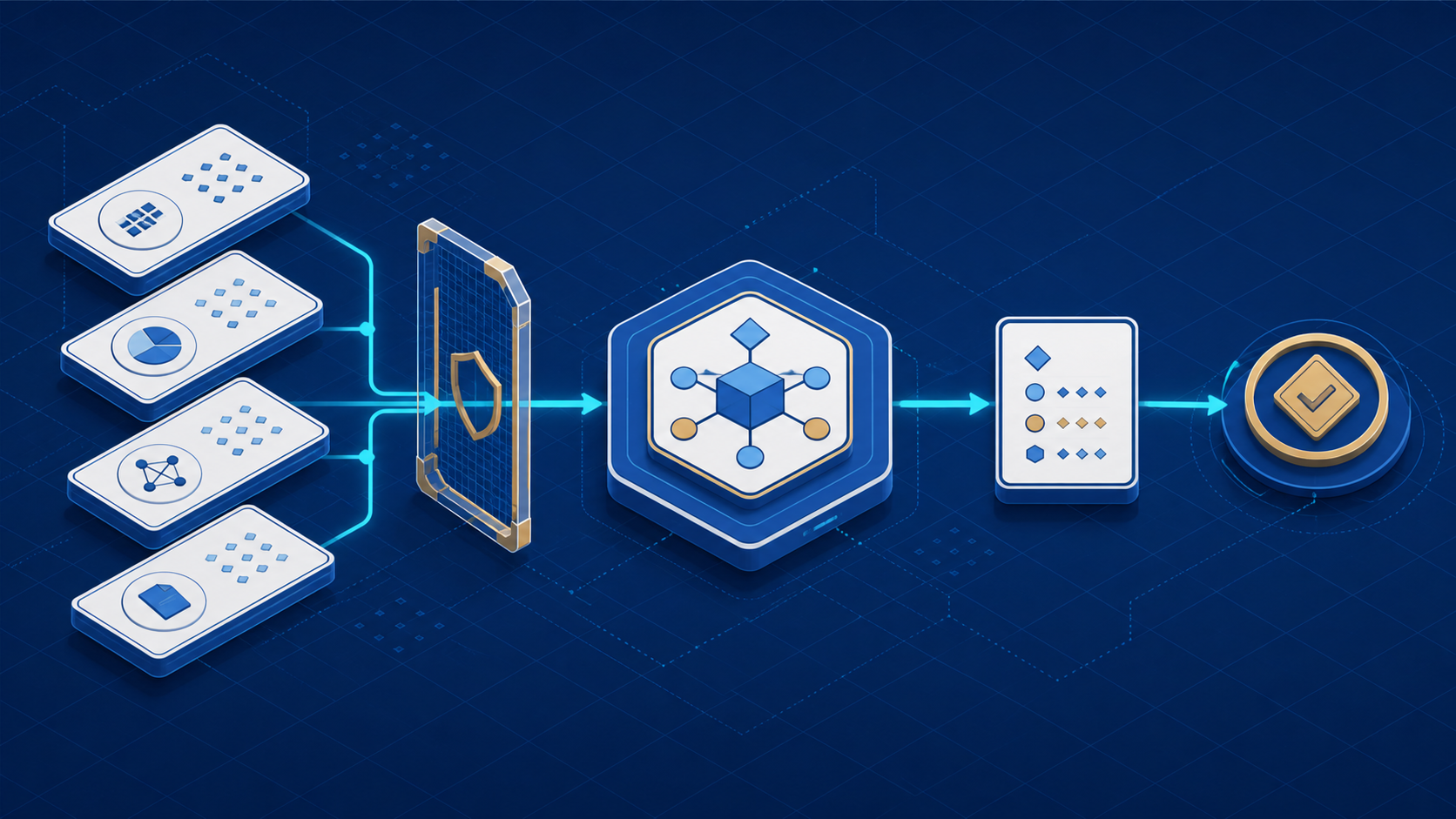
When an AI assistant makes a meaningful recommendation, routes a customer, or declines a request, the useful question is not only “what did it say?” It is “what did it decide, on what basis, and who can improve that decision next time?” AI decision records give a small team an answer without turning every workflow into a compliance project.
Table of Contents
The answer is not the decision
Most teams can see an assistant’s final answer. That is the easy part. The harder part is seeing the chain of judgment behind it: which source it treated as authoritative, which rule it applied, what uncertainty it noticed, which route it selected, and whether a person overrode it.
That distinction matters as soon as AI does more than draft. A website assistant may choose to answer an integration question directly, ask a clarifying question, or hand it to a human. A sales workflow may recommend a standard package, flag a custom requirement, or hold a promise for review. These are decisions with consequences, even when the interface makes them look like ordinary chat.
When the outcome is disappointing, a transcript rarely tells an operator what to change. It leaves them scrolling through prose and guessing whether the problem was a stale source, an unclear policy, a bad route, or a missing approval. That is why a source-of-truth contract and a lightweight incident review work better when the system can show its decision in a compact, repeatable form.
What AI decision records contain
AI decision records are not a transcript archive. They are a short receipt for a consequential choice. For a small business, five fields are enough:
- Decision: what the assistant chose to do, not merely what it said.
- Evidence: the approved source, customer input, or tool result that mattered most.
- Rule: the policy, threshold, or instruction that shaped the route.
- Confidence and alternatives: what made the assistant proceed, ask, escalate, or abstain.
- Owner and version: the human responsible for the lane and the workflow version that made the call.
Consider a visitor asking whether a bespoke deployment includes an on-site workshop. The assistant should not manufacture a reassuring answer. Its record might say: “Escalated; no approved public source covers bespoke workshop terms; custom-scope rule applied; sales owner notified; workflow version 1.4.” The human can act quickly, and the team can later decide whether the knowledge base or the rule needs changing.
This is closely aligned with the NIST AI Risk Management Framework’s emphasis on traceability and documented governance. It is also more practical than pretending a model can supply a perfect explanation of its internal reasoning. Record the observable business inputs, rules, route, and outcome. Those are the things an operator can verify and improve.
Start with one decision that matters
Do not log every autocomplete. Start with one decision that can create a commitment, a customer expectation, or meaningful rework. Good candidates include a pricing exception, a security-question response, a lead qualification route, a refund recommendation, or an escalation from a website conversation.
Then make the record part of the workflow rather than an after-the-fact report. If the assistant selects “answer directly,” create the record before it sends. If it selects “escalate,” place the same record in the human’s handoff card. If a person overrides the choice, capture the override and one sentence of reason. That is the moment when AI decision records become a learning asset instead of an audit burden.
There is a useful discipline here: each field must justify its place by supporting a real next action. If nobody will read a confidence label, do not collect it. If an owner cannot change a policy or source, name the person who can. The point is operational clarity, not a decorative dashboard.
Make the record useful to humans
The best AI decision records fit on a screen and arrive where work already happens. A sales lead needs a two-line reason and a source link, not a model trace. An operator reviewing the week needs patterns: Which decisions were reversed? Which rule caused the most escalations? Which source appeared in customer-facing promises?
That creates a healthier conversation between builders and operators. Instead of “the AI was wrong,” a team can say, “this route lacked an approved source,” or “our custom-pricing rule is too broad.” The OECD AI Principles frame accountability as a shared responsibility across the people and organisations deploying a system. A concise decision record turns that principle into a weekly habit.
It also respects privacy. Do not retain a full customer transcript by default just to make a record. Store the minimum business evidence needed to explain the route, link to governed source material, and apply the same retention and access rules you would to any operational record. Explanation should not become an excuse for collecting more personal data.
Legibility is a competitive advantage
As models become easier to buy, a business’s advantage will not come from claiming that its assistant is mysterious and smart. It will come from making the service dependable: clear boundaries, accountable decisions, and a human who can see what happened when something matters.
AI decision records are a modest place to begin. Pick one decision this week. Write the five fields. Put the receipt next to the outcome. After a few weeks, you will have something more useful than a pile of chat logs: a map of how your business actually delegates judgment—and where people should stay close.


Leave a Reply