
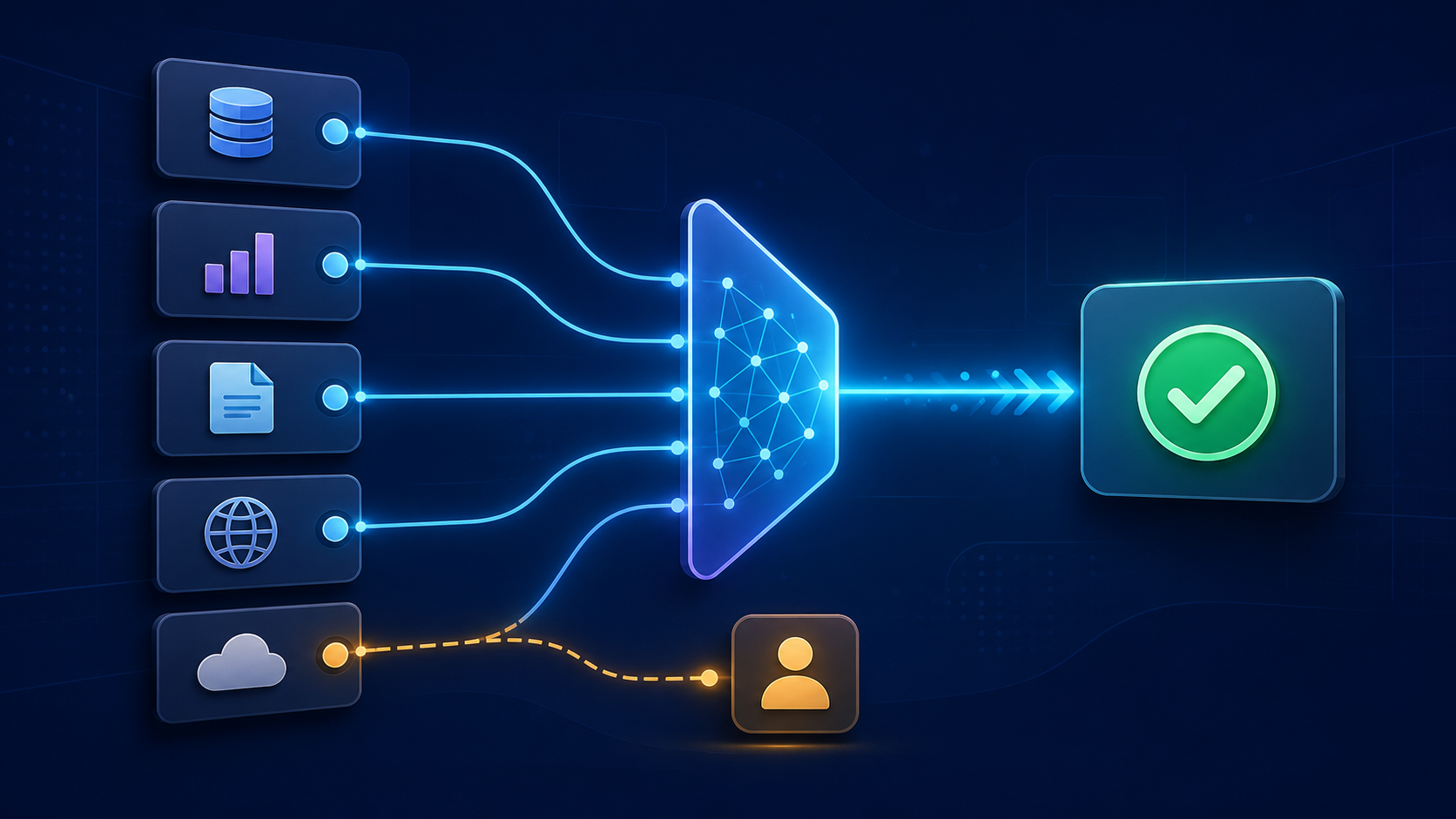
AI source of truth is the missing rule behind many polished, wrong business answers. The model is often blamed when the real problem is simpler: it was given two credible sources that disagreed, and nobody told it which one wins.
Table of Contents
The agent is not the source of the conflict
Picture a visitor asking whether an integration is included in a plan. The public pricing page says one thing. A sales deck from last quarter says another. The CRM has a note from a custom deal. A support article describes an older package. An assistant with access to all four has a confidence problem only because the business has an authority problem.
Most teams respond by adding a caveat to the prompt: “be accurate” or “use the latest information.” That is not a decision rule. It asks a probabilistic system to arbitrate a policy that the people who run the business have not made explicit.
This is where an AI source of truth becomes practical. It is not a giant knowledge-management project. It is a short contract that says which source has authority for a particular kind of answer, who owns it, and what happens when the sources disagree.
What an AI source of truth contract contains
The useful unit is not “all company knowledge.” It is a customer promise: price, availability, implementation timing, security posture, refund policy, or a product capability. For each promise, define four things.
- Authority: the source the assistant may treat as decisive. For public plan features, that may be the approved pricing page; for a signed customer agreement, it is the agreement itself.
- Scope: where that authority applies. A CRM note can guide an account manager’s preparation without becoming a public answer.
- Owner: the person or team accountable for correcting the source, not merely someone who can edit it.
- Conflict route: the exact next step when a lower-ranked source differs from the authority: ask a clarifying question, offer a human handoff, or decline to state the claim.
This resembles the data-governance principle of assigning clear stewardship rather than assuming a shared folder is self-governing. The NIST AI Risk Management Framework makes the same broader point: trustworthy AI depends on defined roles, documentation, and traceability—not only model performance. The OECD AI Principles likewise put transparency and accountability at the centre of trustworthy systems.
An AI source of truth contract also gives a small team a better internal conversation. Instead of debating whether the assistant “should have known,” they can ask: which source was allowed to decide this claim, and was that rule available in the workflow?
Make disagreement a route, not a guess
The important design move is to make a conflict visible before it turns into a customer promise. An agent does not need to recite every source it considered. It does need a sensible route when its approved sources do not settle the question.
For a website assistant, that route can be pleasantly simple: answer directly when the approved public source is clear; ask one question when eligibility changes the answer; hand off when a customer-specific commitment is involved. That is a better experience than a fast, definitive answer that sales must unwind tomorrow.
There is a useful connection here to AI knowledge expiry. Expiry asks when a source should stop being used. Authority asks which valid source wins today. You need both: a fresh but low-authority slide should not override an approved policy, and an authoritative page that has not been reviewed should not keep speaking forever.
Make the route inspectable in the workflow. In a visible agent plan, a pricing question can pass through an approved-source check before it reaches the answer step. If the check fails, the workflow creates a concise handoff with the conflicting sources and the visitor’s question. The human sees a decision to make, not a mysterious model failure.
This is also a privacy win. The system should retrieve only the source class needed for the promise at hand. A public feature question rarely needs a customer’s full CRM history. A narrow source hierarchy reduces both invented answers and unnecessary exposure of sensitive context.
Start with one customer promise
Do not begin by cataloguing every document in the company. Pick the claim your assistant is most likely to make that would be painful to reverse—usually pricing, availability, eligibility, or security.
- Write the promise in one sentence.
- Name its approved source and owner.
- List the sources that may inform but cannot override it.
- Write the conflict response in plain language.
- Test it with one ordinary question and one contradictory-source question.
That small exercise changes the quality of the system quickly. It turns “the AI knows our business” into a more honest and useful claim: the AI knows which business source is allowed to speak, and it knows when to bring in a person.
Keep the contract close to the people who change the promise. A product manager, sales lead, or support owner should be able to read it in two minutes and challenge it when reality changes. If the rule only exists in an engineer’s head, it is not yet a reliable AI source of truth.
The goal is not to make every answer slower or more cautious. It is to make your confident answers earned. When an AI source of truth is explicit, customers get clearer commitments, operators get cleaner escalations, and the business keeps control of the promises made in its name.


Leave a Reply