
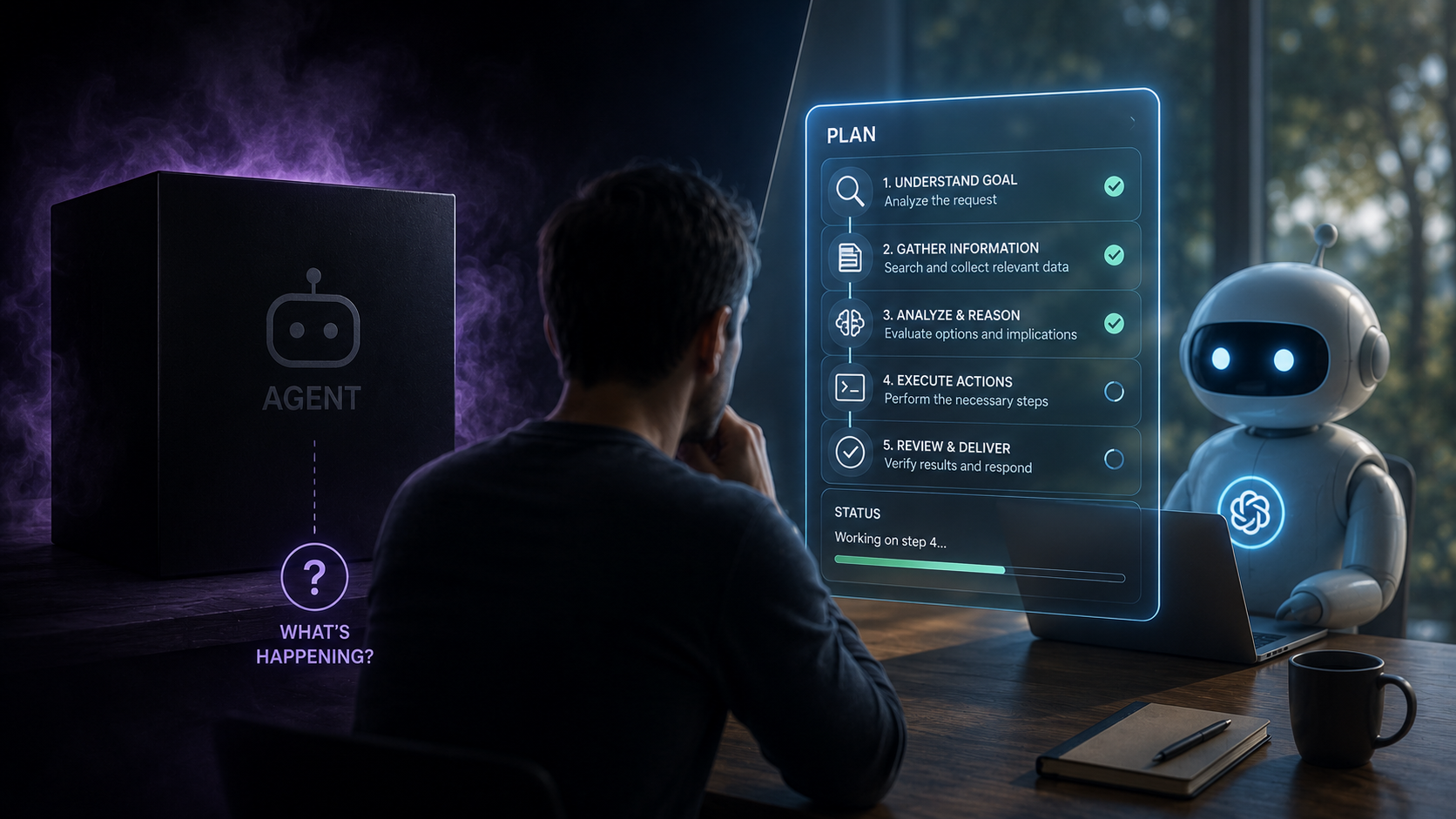
The first generation of business AI was easy to supervise because it did one thing at a time. You asked, it answered, you checked the answer. The model was a black box, but the interaction was small enough that a human could read the output and decide whether to trust it.
Agentic AI breaks that arrangement. An agent does not answer. It plans. It pulls data, calls tools, branches on conditions, writes files, sends messages, and hands off to people or other agents. By the time you see the output, a dozen steps have already happened, and most of them are invisible. The unit of work has grown from a single response to a whole workflow, and the unit of trust has to grow with it.
Here is the problem nobody has fully solved yet: you cannot supervise a plan you cannot see. And right now, most business agents run their plans in the dark.
The plan is the new prompt
When AI was a single chat response, the prompt was the artefact you tuned. You rewrote it, saved versions, compared outputs. The prompt was where the craft lived.
With agents, the prompt is still there, but it has been dwarfed by something larger: the plan. The plan is the sequence of steps the agent intends to take, the tools it will call, the data it will touch, the branches it will follow, the conditions it will check, and the points where it will pause for a human. The plan is the prompt, expanded into time and action.
Most teams never see it. They see a request go in and a result come out, and they infer what happened in between from logs that were built for debugging, not for supervision. That is fine for a demo. It is dangerous in production.
Invisible plans are unsupervisable
Think about how you would onboard a new hire. You would never say “here are your credentials, go do the job, and tell me how it went on Friday.” You would walk through the steps. You would show them the workflow. You would point at the places where they should stop and ask. You would make the plan visible so you could correct it before it became a habit.
Agents deserve the same treatment, and for the same reason. A plan you cannot see is a plan you cannot approve, cannot adjust, and cannot improve. You are left with two bad options: trust the agent blindly, or don’t use it at all. Both cost you. The first costs you control. The second costs you the work.
This is why the next real product layer in agentic AI is not a bigger model. It is visibility. The agent’s plan, rendered as something a human can actually look at.
What a visible plan actually gives you
A visible plan is not a flowchart for its own sake. It is a control surface. Four things become possible the moment you can see the agent’s intended path:
- Approval before action. When the plan is visible, you can insert a checkpoint before the step that sends the email, charges the card, or updates the customer record. The agent shows you what it is about to do, you confirm or redirect, and only then does it proceed. This is the difference between an agent that acts and one that proposes.
- Data legibility. A rendered plan shows which data sources each step touches. You can see, at a glance, whether the agent is about to pull customer-identifiable information into a public cloud call. That is a privacy decision rendered as a diagram, not buried in a config file.
- Debugging by structure, not by log. When an agent produces a wrong result, the first question is always “what did it actually do?” A visible plan answers that question immediately. You see the branch it took, the tool it called, the input it passed. You stop reading timestamps and start reading the workflow.
- Faster improvement. A plan you can see is a plan you can edit. You can tighten a branch condition, add a guardrail step, move an approval gate earlier. The workflow becomes a thing your team improves on purpose, the way you improve a process document, instead of a prompt you blindly retry.
Start with one visible workflow
The mistake teams make with agentic AI is trying to automate something complicated first, to prove the technology. Do the opposite. Pick one workflow that is already understood, already documented, already run by a person who could explain every step. Render that workflow as a visible plan. Let the agent run inside it. Watch it. Adjust it. Add an approval gate. Remove one. See what changes.
A good first candidate is website coverage. The workflow is already legible: a visitor arrives, the assistant qualifies them, answers a question, routes the conversation, and hands off to the morning team. Every one of those steps is something a human salesperson already does. When you render that as a visible plan, you can see exactly where the agent acts, where it pauses, and where the human picks up. You are not handing a stranger the keys to your front door. You are watching a new hire follow a checklist you wrote.
Why this is a product question, not a model question
The model vendors will keep competing on capability. That is their job. But capability without visibility just produces faster black boxes. The question for operators is different: can my team see what the agent is about to do, and can they change it before it happens?
This is why we have been building meLink avo around visual orchestration from the start. The agent’s workflow is not a hidden chain of calls. It is a canvas. You see the steps, the tools, the data, the branches, and the approval gates. You can watch the plan execute. You can edit it while it runs. The plan is the product surface, not a debug artefact.
That choice comes from a simple belief: people are better supervisors than they are spectators. Give someone a plan they can see and they will improve it. Give them a black box and they will either fear it or ignore it. Neither is adoption.
The closing test
Here is a useful test for any agentic AI you are about to put into production. Before you switch it on, ask the person who will own it day to day: can you draw me the plan the agent will follow?
If they can draw it from memory, you have a supervised agent. If they cannot, you have a black box with credentials. Fix the visibility first. The capability will keep improving on its own. The trust will not, unless you build the surface for it.
You’ve got this.

Leave a Reply