
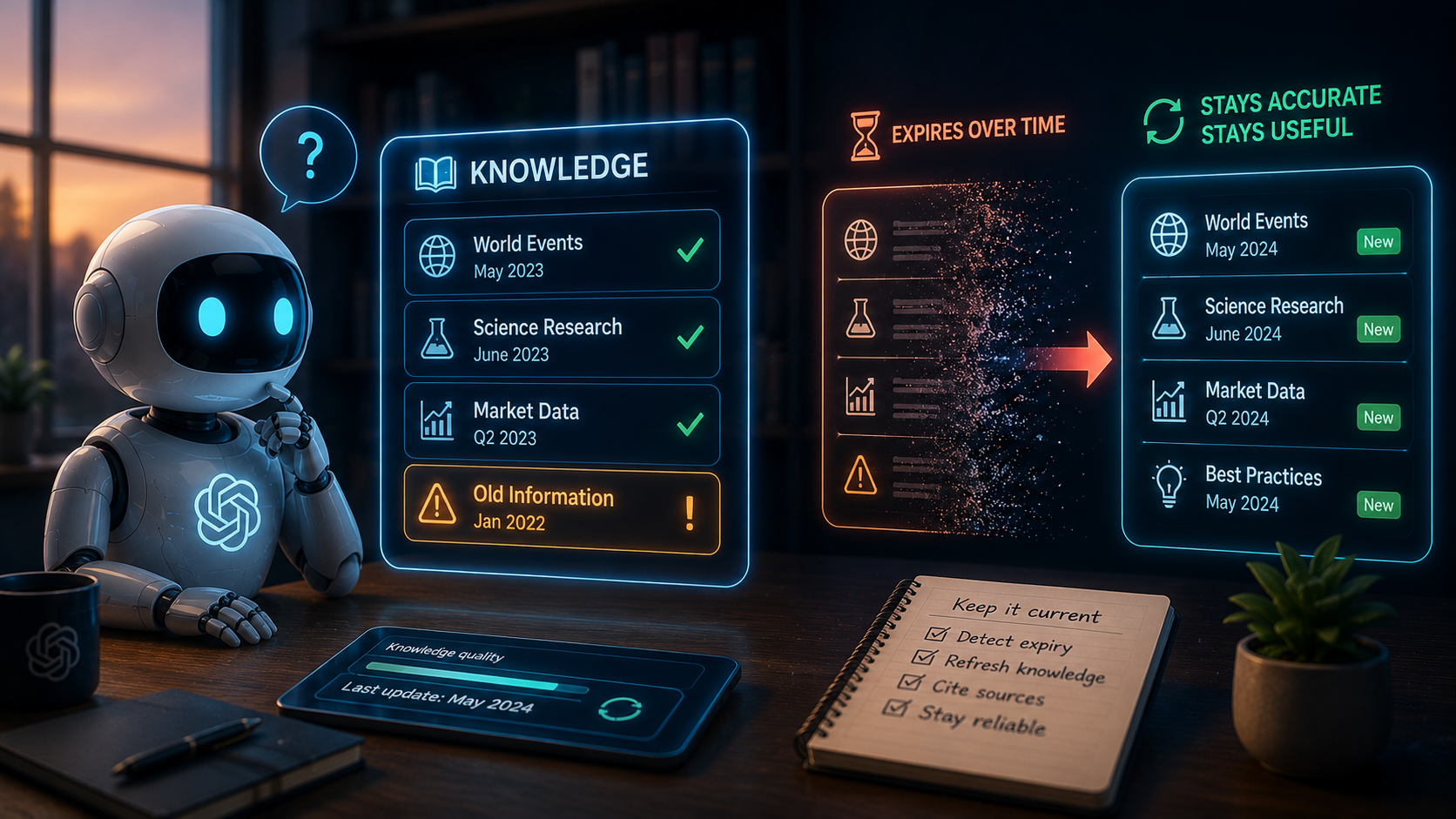
Every business has a few things it used to believe with complete confidence: an old price sheet, a retired integration, a policy that changed after one difficult customer, a sales deck from before the product moved on. Put that material in front of an AI assistant and it does not see history. It sees instructions.
That is why stale knowledge is more dangerous than missing knowledge. A missing answer can trigger a useful question. A stale answer can sound perfectly helpful while promising something your business no longer does.
AI knowledge expiry is a simple operating rule: every source an assistant can rely on should have an owner and a point at which it must be reviewed, renewed, or retired. It is not glamorous. It may be one of the most practical trust features a small team can build.
AI knowledge expiry is a customer-experience issue
Most teams think of their AI knowledge base as a library. Collect the PDFs, FAQs, product pages, support answers, and sales notes; give the assistant access; move on. The better metaphor is a shop floor. Every item needs a label, a place, and someone responsible for taking it away when it is no longer safe to use.
Consider a website assistant answering a visitor’s question about implementation. It finds a six-month-old document that says a particular integration is included in the standard plan. In the meantime, the product changed and that integration became a paid add-on. The assistant is not hallucinating. It is faithfully repeating a promise the business left lying around.
To the visitor, the distinction does not matter. They heard it from your website. The correction arrives later, after trust has already been spent.
Freshness is not the same as more context
When an assistant gets something wrong, the default response is often to add more documents. That can make the problem worse. More context gives the model more chances to find a contradictory, obsolete, or audience-specific answer. A long knowledge base without stewardship is not institutional memory. It is a confident jumble sale.
The useful question is not, “What else can we upload?” It is, “Which sources are allowed to speak for us today?” That is a smaller and more disciplined set.
This matters especially for a lean team. People change a price, launch a feature, update a policy, or learn a better way to explain the product. The human who made the change carries it in their head. The assistant only knows if the operating system around it makes that change visible.
Give every important source a life cycle
You do not need a heavyweight governance programme to start. For the material that can affect a customer, a contract, or a decision, keep four small fields:
- Owner: the person who can say whether this is still true. Not “the team”; a named human.
- Last reviewed: when someone last checked it against the real business.
- Review date: when the assistant should stop treating it as current unless it is renewed.
- Scope: where it may be used — public website answers, internal drafting, customer support, or nowhere without human review.
The review date should match the cost of being wrong. A product price, service availability, security claim, or legal policy needs a short clock. A stable explanation of your founding story can have a longer one. Some documents should never be used for public answers at all, no matter how recent they are.
When a source reaches its review date, the system does not have to delete it. It can remove it from the assistant’s public-answer set, flag it for review, and keep it available as internal history. That distinction is important: retirement is not forgetting. It is choosing not to present yesterday’s truth as today’s commitment.
Build a “do not answer from this” lane
The most useful knowledge systems have a visible quarantine lane. Old release notes, superseded proposals, customer-specific exceptions, and half-finished internal thinking may all be valuable. They just should not be retrieved as the authority for a live customer answer.
This is where privacy and accuracy meet. A private internal note may contain useful context but also a customer name, a negotiation position, or an assumption that was never meant to become a public promise. Good boundaries protect both the business and the person asking the question.
In an orchestrated workflow, this can be concrete: the website assistant searches only approved, in-date public sources; an internal assistant may search a wider set but must cite the source; anything expired routes to a human instead of being turned into fluent prose. The goal is not to make the agent timid. It is to make its authority legible.
The first audit is smaller than you think
Do not begin by cataloguing every file your business has ever created. Start with the ten answers that shape real outcomes: what you sell, what it costs, who it is for, how it works, what it integrates with, what you promise on security and privacy, and where a human needs to step in.
For each one, ask three questions:
- What source would our assistant use to answer this right now?
- Who would notice first if that answer became wrong?
- What date would make us uncomfortable leaving it unattended?
That short audit usually exposes the real work. Maybe pricing lives in three places. Maybe the product team changed language the sales deck still contradicts. Maybe no one owns the security FAQ. These are not AI problems created by an AI project. They are business truths an assistant makes impossible to ignore.
Expiry turns a knowledge base into a promise system
The opportunity in AI is not to make every document answerable forever. It is to give customers and teams useful help without quietly turning stale material into a commitment.
meLink web is built around the idea that a website should offer real coverage, not just a louder chat box. meLink avo extends the same principle into visible workflows: you should be able to see which source was used, which rule applied, and where the system chose to ask for help. That is what human-first automation looks like in practice — clear authority, useful action, and a human still responsible for the promises that matter.
You have not finished the knowledge base when it is full
You have finished the first useful version when it knows what it is no longer allowed to say.
Give your assistant an expiry date for knowledge that can change. Give each promise an owner. Then let the system ask before it turns a memory into a commitment. That is not less intelligent automation. It is the kind people can trust.


Leave a Reply