
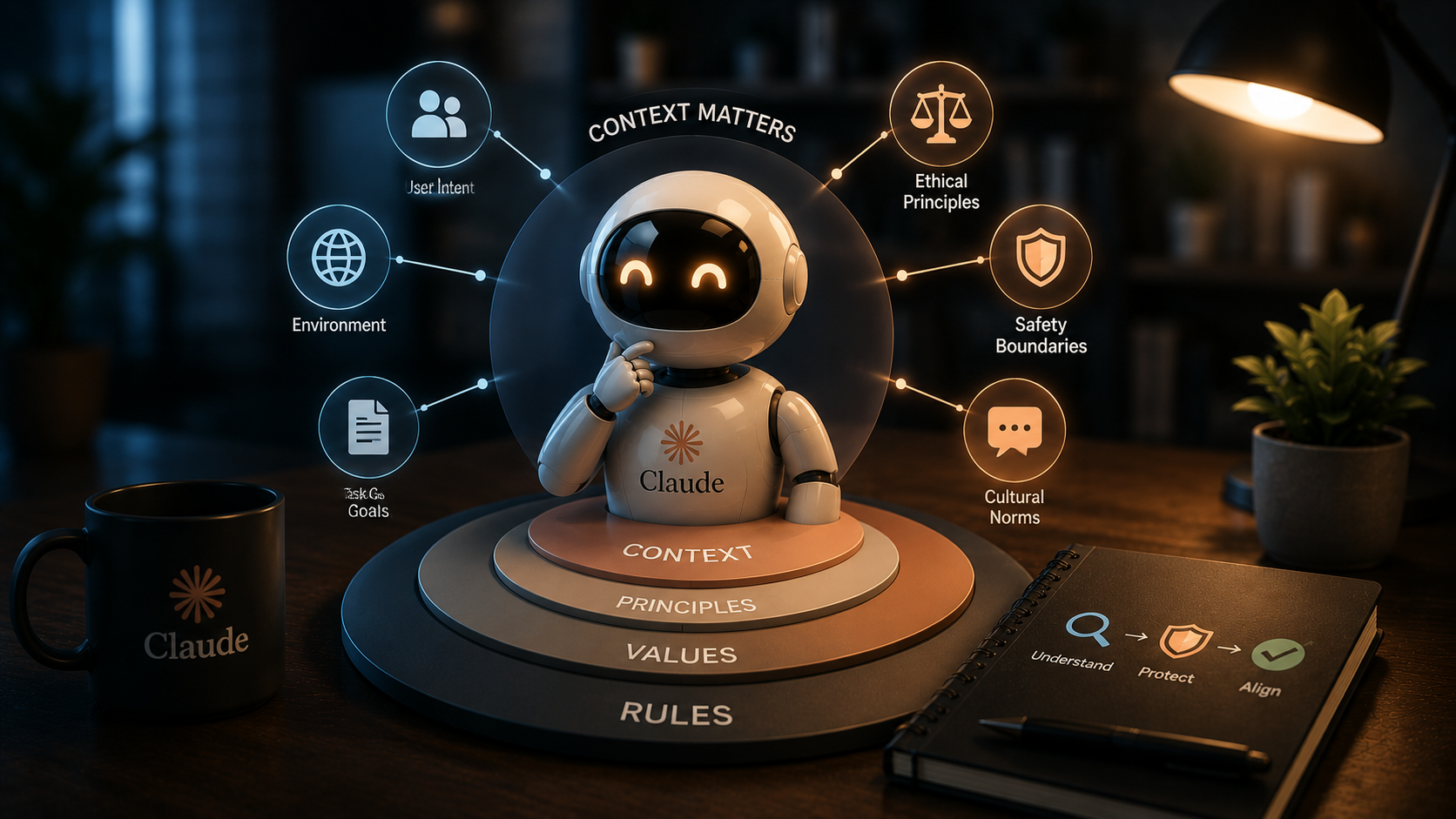
Anthropic has published a new look at how Claude’s values vary by model and language. It is not a model launch, but it is a timely reminder that the behaviour of an AI system is not a fixed property you can copy from a benchmark sheet into a product plan. For anyone building an assistant that acts on behalf of customers or colleagues, language, model choice and the surrounding workflow can all change what “safe” and “helpful” look like in practice.
The big signal: Claude values are not one universal setting
Anthropic’s latest research, “How Claude’s values vary by model and language,” puts a useful operational question in front of the industry: do a model’s stated values survive a change in language or model variant? The answer matters well beyond a research paper. A business may describe its policy once, then serve customers in several languages, route requests to different models for cost or speed, and add tools that let an agent take action.
That stack has more moving parts than a single chat window. A system can be well behaved in an English demonstration and still need careful evaluation when it is handling a German sales enquiry, a multilingual support handoff or a request assembled from a customer’s website data. The practical lesson is not that multilingual AI is unusable. It is that “the model is aligned” is too coarse a deployment criterion.
For investors, the important signal is that reliability work is moving from broad model labels to observable product behaviour. The durable companies will not just buy access to a strong model. They will know which model is doing which job, what it may access, which languages and customer journeys have been tested, and where a person takes over.
An agent’s behaviour is a property of the whole system: model, language, instructions, data, tools and escalation path.
Open-source watch: security tools are becoming agent infrastructure
There was one smaller, practical open release worth tracking alongside the Claude research. Ant Group announced SingGuard-NSFA, an open-source project aimed at security for autonomous AI agents. The announcement is useful less as a verdict on any one library than as evidence of where the tooling is going: agent security is becoming a product surface rather than a final compliance review.
That fits the recent direction of local and open-model tooling. Ollama 0.32.0 added an agent UI and model-specific parsing support, while vLLM 0.25.0 made Model Runner V2 the default for dense models. Neither is fresh enough to replace today’s headline, but together they show why teams increasingly have a real choice: use a frontier API where it earns its keep, and keep more controlled workloads closer to their own infrastructure.
What builders should take from this
- Test the workflow, not only the model. Run the same important task across the languages your customers use, the models your router may select, and the tools the agent can call.
- Make boundaries explicit. Put permissions, approved sources, transaction limits and handoff rules in the orchestration layer. Do not expect a general model preference to do that work alone.
- Keep a reviewable trail. Save the input context, selected model, tool calls and final action for high-impact tasks. This is how a small team can investigate a bad outcome without guessing.
- Use model diversity deliberately. A lower-cost or local model can be a sensible option for bounded work, but it deserves its own evaluations rather than inherited trust from the premium model.
This is particularly relevant for website assistants. A visitor does not care which model answered; they care whether the answer is accurate, whether their data was handled respectfully and whether a real person can step in when the request becomes consequential. An always-on sales or support assistant should therefore be designed as a controlled service: clear scope, reliable retrieval, visible uncertainty and a graceful route to a human.
It also changes how teams should report quality. A single aggregate score can hide the differences that matter to customers. Track outcomes by language, task type, selected model and action permission. Review a small sample of conversations regularly, especially the ones that were escalated or corrected. That creates a feedback loop for prompt changes and routing rules without treating every conversation as an experiment on a customer.
The practical takeaway
Claude’s values-by-language research is a quiet but important correction to simplistic AI procurement. Model capability still matters. But practical adoption will be decided by whether a team can keep behaviour consistent across contexts and explain what happened when it is not.
Start with one customer-facing workflow. List the languages, models, data sources and actions involved. Test a small set of normal, ambiguous and out-of-scope cases in each language. Then decide where the agent should answer, ask, pause or hand off. That is less glamorous than chasing the next benchmark, and much closer to building an AI service people can trust.
Sources: Anthropic; Ant Group announcement; Ollama release notes; vLLM release notes.

Leave a Reply