
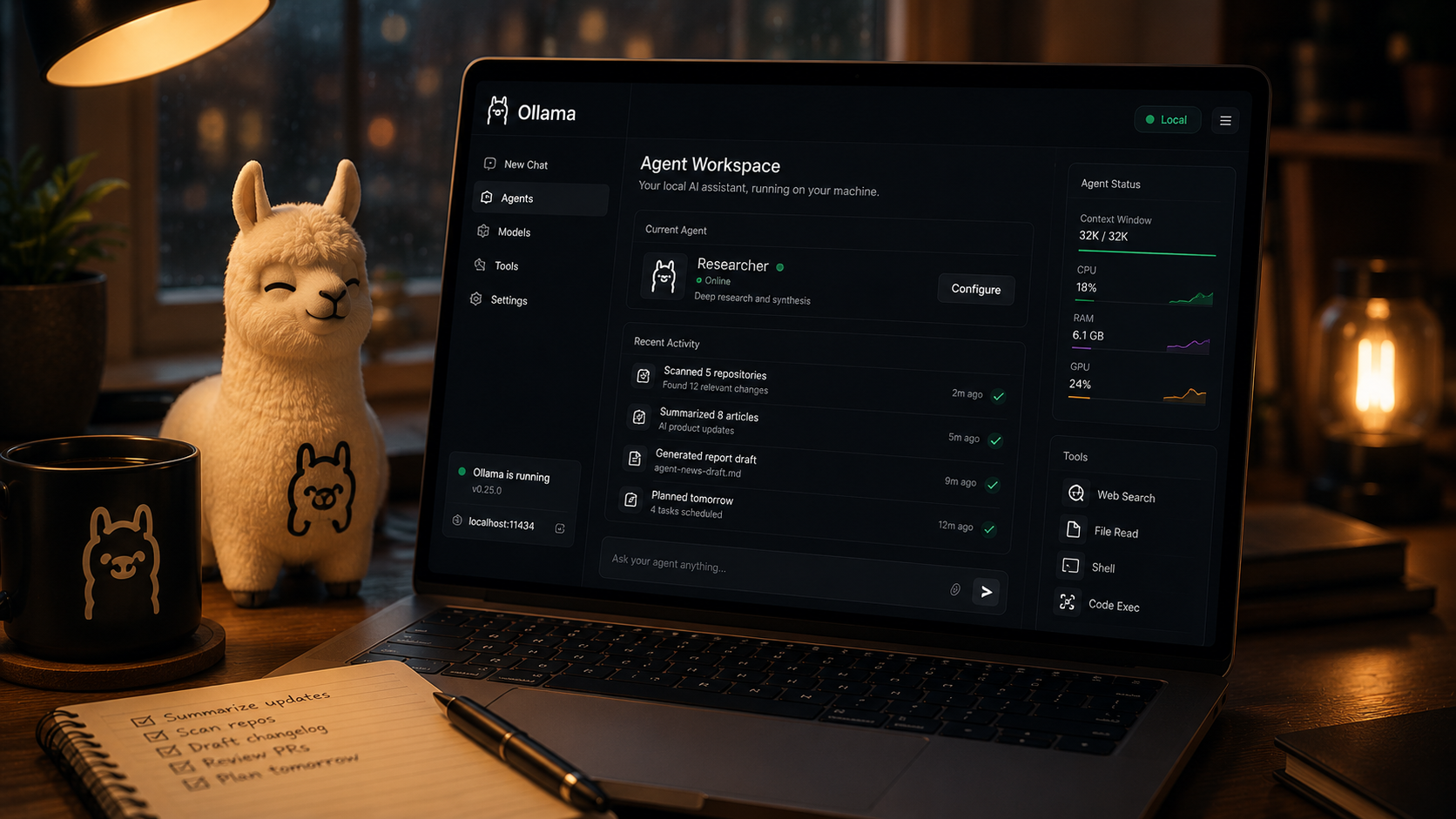
There is no verified frontier-model launch to chase this morning. That is useful information in itself. A recent practical release is Ollama v0.32.0-rc0, which introduces an agent UI, warns users before selecting older agent models, and adds Qwen3.5 parser and renderer selection. It is a small release candidate, not a claim that local models have caught up with Claude, GPT or Gemini. But it points at a more important change: local AI tooling is being shaped around operating agents, not merely running a chat model.
The big signal: a quiet frontier-news cycle is a product decision window
The daily AI conversation is usually organised around a major lab announcement: a new model, a price change, a capability demo or a policy reversal. A scan of primary frontier-lab news channels and reputable reporting for the past day did not turn up a comparable, verified release. Rather than manufacture a race narrative, it is worth treating the absence as a cue for teams to work on the unglamorous parts of adoption.
For a small business, a website assistant or an internal workflow does not become useful because a benchmark moved. It becomes useful when somebody has decided what it may do, which information it may access, how it explains its actions, and where a person takes over. Those decisions are easy to postpone while every feed is shouting about a new model. They are also where the durable value sits.
That does not mean ignoring frontier providers. Closed models remain important options for tasks that need broad multimodal capability, reliable managed infrastructure or rapid access to the latest features. The operational question is narrower: can an application change provider, model or deployment location without rewriting its permissions, its records and its customer experience? If the answer is no, the model vendor is carrying more of the product than it should.
Open-source watch: Ollama agent UI moves local AI beyond the prompt box
Ollama’s v0.32.0 release candidate lists three changes that matter together: an agent UI, a warning before users choose old agent models, and Qwen3.5-specific parsing and rendering. The release notes are concise, so the right reading is modest. This is not a production recommendation simply because it exists, and a release candidate deserves testing before it is put in front of customers.
Still, the direction is clear. A local runtime historically asks, “Which model do you want to run?” An agent-oriented layer has to ask more: what tools can it call, which model behaviour is suitable for tool use, and what does a human need to see while it works? A warning about old agent models is a small but healthy example of product design acknowledging that model choice changes system behaviour.
The Qwen3.5 parser and renderer selection is similarly practical. Tool calls and reasoning formats are not interchangeable text decorations; an orchestration layer needs to interpret them correctly. Builders mixing local and cloud models should expect this compatibility work to be ongoing. “OpenAI-compatible” is helpful for an API surface, but it is not a guarantee that every model’s tool-use conventions, structured output or failure modes are identical.
What builders should take from this
- Separate the model from the job. Define the user outcome, approved tools and escalation path before choosing between a hosted frontier model and a local one.
- Keep tool permissions explicit. An agent UI can make action-taking feel approachable; it does not make broad access safe. Start with read-only retrieval, drafts or bounded actions.
- Test model changes as workflow changes. When switching models or parsers, check tool calls, structured outputs, refusals, latency and the exact records a user can review.
- Use local AI where control is the requirement. Local deployment can help with privacy, data location and predictable operating boundaries. It also leaves the team responsible for updates, evaluation and support.
Why it matters for the AI community
Investors and operators often treat model releases as the whole market. The more useful indicator is whether capabilities are becoming legible enough to deploy. Interfaces, parsers, model warnings, audit trails and approval steps are less dramatic than a launch video, but they are the pieces that let a small team turn an AI demo into a service it can stand behind.
There is also a healthy division of labour emerging. Frontier APIs can be the right place to buy raw capability. Local and open tooling can be the right place to retain control over sensitive context or to keep a workflow available when a provider changes terms. Good orchestration should make that a considered choice, not an ideological one.
The practical takeaway
Do not let a quiet news day turn into a quiet product day. Pick one agent workflow and write down four things: its permitted actions, its data boundary, the person who can intervene, and the evidence it leaves behind. Then run the same task through the model you use today and one alternative. The result will tell you more about readiness than another generic leaderboard comparison.
Ollama’s agent UI is not the headline-grabbing frontier event that often drives this column. It is a useful reminder that practical AI adoption is increasingly an operations problem. The teams that make those operations visible will have more choice when the next GPT, Claude or Gemini release arrives.
Leave a Reply