
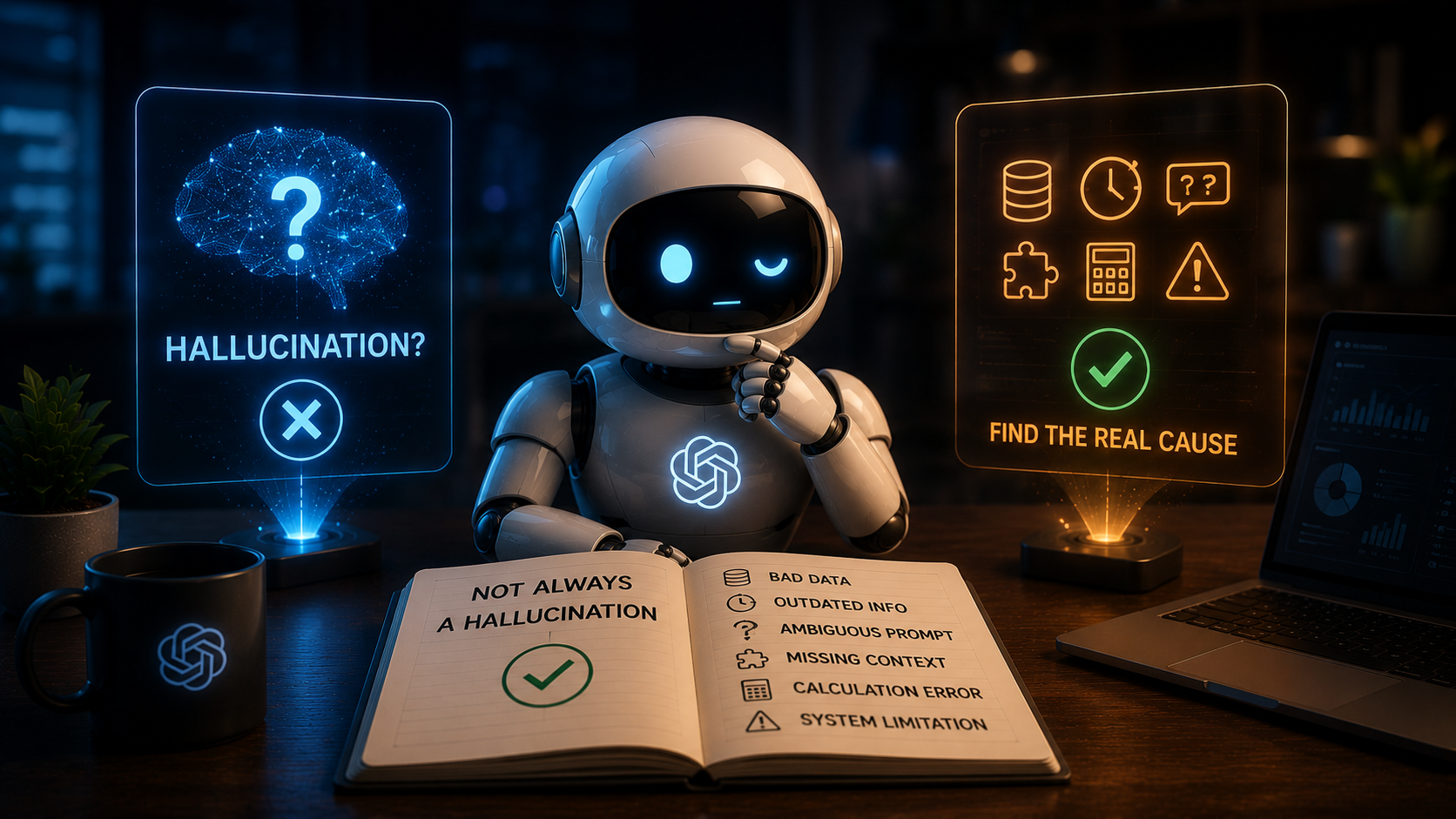
“It hallucinated” is becoming the most expensive sentence in business AI.
Not because it is always wrong. Sometimes an assistant really has invented a detail. But teams use the word as a catch-all for almost every disappointing outcome: the answer used an old price, the workflow sent the right message to the wrong person, a connected tool timed out, or the agent correctly stopped because it was not allowed to proceed.
Those are different failures. They have different owners, different fixes, and different implications for trust. Calling all of them a hallucination feels tidy in the moment, then guarantees the same work gets misdiagnosed next week.
An AI error taxonomy is a small shared vocabulary for that diagnosis. It is not bureaucracy. It is how a small team stops treating every miss as proof that “the AI is unreliable” and starts improving the actual system.
One bad outcome, five very different causes
Imagine a website visitor asks whether a service includes onboarding. The assistant replies yes, but the current package does not. The team may call that a hallucination. Before changing the model, ask a more useful question: what kind of mistake was this?
- Knowledge error: the assistant was given stale, incomplete, or contradictory source material.
- Instruction error: the sources were sound, but the prompt did not tell the assistant how to handle ambiguity, exceptions, or a missing answer.
- Tool or integration error: the assistant reached for the right system but received a failed, partial, or mismatched result.
- Policy-boundary event: the assistant was right to stop, ask, or refuse; the disappointment is really an expectation problem or an unresolved human decision.
- Execution error: the plan was sensible, but a step was performed incorrectly: wrong recipient, wrong timing, wrong field, wrong sequence.
The onboarding answer could be a knowledge error if an old sales deck remained in the public-answer set. It could be an instruction error if the assistant was told to be helpful but not told to distinguish standard packages from custom work. Those are not cosmetic differences. One needs content stewardship; the other needs a better job description for the assistant.
Why the label changes the next move
Without a taxonomy, every incident invites the same response: try a newer model, add more prompt text, or put a person in front of everything. Each can be sensible. None is a diagnosis.
A knowledge error calls for an owner, a source correction, and perhaps an expiry date for the old material. An instruction error calls for a clearer constraint or an example. A tool error calls for retries, validation, observability, or a fallback path. A policy-boundary event calls for a decision about authority. An execution error calls for an inspection of the workflow itself: its branch, destination, timing, or approval gate.
The useful question is not “Why was the AI wrong?” It is “Which part of the system made this outcome possible?”
This is especially important when an assistant can do more than answer. Once it can look up records, draft communications, route leads, or trigger a workflow, model quality is only one component of the experience. The system includes sources, instructions, tools, permissions, timing, and people. A single label hides that reality; a useful label exposes where to work.
Start with a five-label review, not a giant evaluation programme
You do not need a committee or a dashboard full of red dots. Start with a shared note, form, or lightweight queue. For every meaningful miss, record five things:
- What happened? Save the user request, the outcome, and the impact in plain language.
- Which label fits best? Choose knowledge, instruction, tool, policy boundary, or execution. If two fit, choose the first failure in the chain.
- What evidence supports that label? Link the source, prompt version, workflow step, or tool response rather than relying on memory.
- Who owns the fix? Name a person, even when the answer is “we need a business decision first.”
- How will we know it is fixed? Add one representative case that the revised system must handle correctly.
That last point matters. A fix is not “we changed the prompt.” A fix is “this visitor question now receives the correct standard-package answer, and custom cases are routed to a person.” The test connects a change to the customer experience it is supposed to protect.
A taxonomy makes visual workflows more useful
Visual orchestration earns its keep here. A workflow canvas can show the knowledge source, the instruction, the tool call, the approval point, and the action as separate pieces. When something goes wrong, the team can point to the failing layer instead of staring at one long transcript.
That makes the conversation less defensive. The person who owns product information is not being asked to become a prompt engineer. The person building the workflow is not being blamed for an outdated policy. Each person can see the part they own and the dependencies around it.
This is a practical reason to keep agent workflows legible. An AI system should not merely produce a result; it should leave enough structure behind for a team to learn from the result.
Do not use the taxonomy to excuse bad outcomes
A label is not a loophole. A customer does not care whether a wrong answer came from stale data or an integration. They care that it was wrong. The point of classification is to make the response faster and more honest: correct the issue, contain any harm, and improve the right layer.
It also reveals patterns that individual incidents cannot. If most problems are knowledge errors, do not buy a more capable model first; repair the source process. If policy-boundary events are piling up, leaders have decisions to make about what the assistant may do. If execution errors cluster around one branch, redesign that branch before adding more autonomy.
Trust grows when the team can name the failure
The businesses that get durable value from AI will not be the ones that pretend their systems never fail. They will be the ones that can look at a miss without drama, name it accurately, and make one accountable improvement.
That is a human-first standard. It keeps responsibility with the people who own the business, while giving the assistant a clearer environment in which to be useful. Start with five labels. The next time someone says “it hallucinated,” ask which layer failed. You will have a much better place to begin.


Leave a Reply