
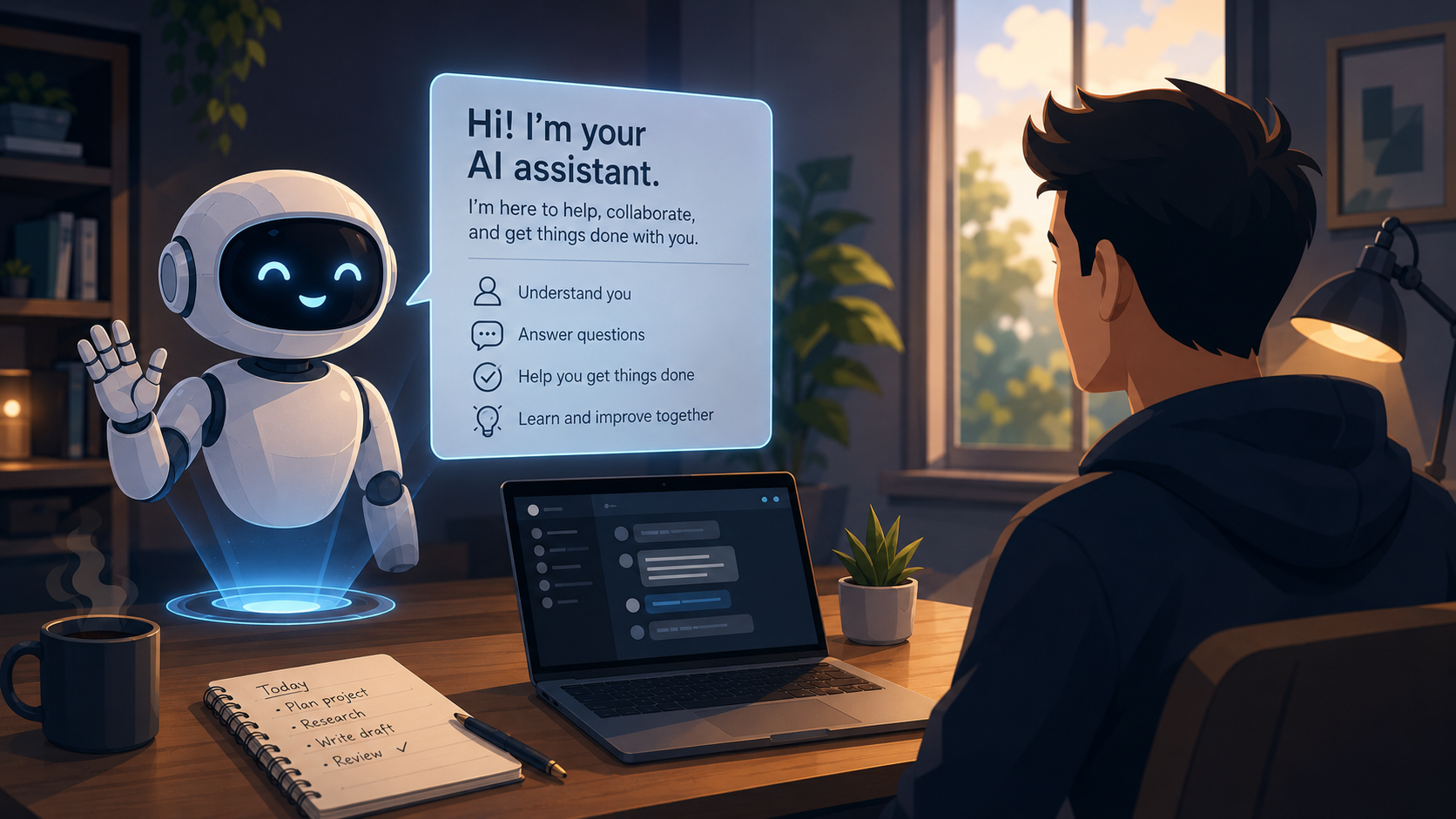
A customer lands on your website at 9:47pm, asks a practical question, and gets a fluent answer in seconds. Good. But before they share their situation, book time, or make a decision based on that answer, they deserve to know something simple: who—or what—they are talking to.
Too many businesses treat that as a cosmetic detail. They give an assistant a friendly name, a chat bubble, and a very good prompt. The visitor is left to infer the rest.
That is backwards. AI assistant disclosure is not a legal footer or an apology for using technology. It is the front door of a useful service. A clear introduction tells a person what this assistant is, what it can help with, where its answers come from, and how to reach a human when the conversation needs one.
The awkward moment happens before the mistake
Most teams think about disclosure after a failure: the assistant gave a poor answer, sounded too human, or collected something it should not have. The better moment is the first message.
Imagine two opening lines. One says, “Hi, how can I help?” The other says, “I’m the meLink website assistant. I can help with product questions and route your request to the team. I use the information you share here to continue this conversation; for account or contract questions, I’ll bring in a person.”
The second is not less welcoming. It is more respectful. It gives the visitor enough context to choose what to ask, what not to share, and when to ask for a human. That choice is part of the product.
AI assistant disclosure is a service design decision
A useful disclosure does more than label a bot. It makes the service legible. For a customer-facing assistant, four plain-language answers matter:
- What is this? Say that it is an AI assistant and name the business or team behind it.
- What can it help with? State the lane: product information, finding the right page, qualifying a request, booking a conversation, or something else specific.
- What is it working from? Explain at a useful level whether answers come from approved website information, a knowledge base, or details supplied in the chat. Do not pretend it has access to systems it does not.
- What happens next? Make the human route visible. A visitor should never have to perform a confidence test on the assistant just to find a person.
This is a small design exercise, but it forces valuable decisions. If the team cannot explain what the assistant knows, who owns it, or where a sensitive question goes, the issue is not the wording. The service is not ready yet.
A name is not an identity
Giving an assistant a name or personality can make an interaction warmer. It cannot substitute for identity. “Ask Ava” tells a visitor almost nothing about whether Ava is a person, an agent, an inbox, or a route into a larger system.
Identity is operational. It connects an assistant’s words to a real organisation, a defined scope, and a responsible owner. When the assistant says it can help with a product question, that should mean someone has decided which sources count as current. When it offers a meeting, someone should own the calendar and the follow-up. When it cannot answer, its escalation should lead somewhere real.
This is especially important on a website. A visitor does not see the internal workflow behind the chat. They see one interface and reasonably assume the business stands behind it. The assistant is not a side experiment from their point of view; it is part of the company’s front desk.
Make the privacy boundary understandable
Privacy language often swings between vague reassurance and a dense policy link. Neither helps someone decide what to do in the moment.
Start with the immediate boundary instead. If a visitor should not put account numbers, health details, contract terms, or other sensitive information in chat, say so before it matters. If a conversation may be retained to help the team follow up, say that plainly. If the assistant uses only public product information for a particular lane, that is worth saying too.
Clear boundaries do not make an assistant feel less capable. They make its capability believable. In a privacy-respecting product, restraint is evidence that the system has been designed on purpose.
The first-message test for AI assistant disclosure
Before adding another feature, read the assistant’s first message as if you were a new customer. Can you answer these questions without opening a policy page?
- Do I know I am speaking with an AI assistant?
- Do I understand what it is here to do?
- Do I know what kind of information is appropriate to share?
- Can I get to a human without making the conversation fail first?
If any answer is no, improve the introduction before improving the model. This does not require a long disclaimer. It requires one honest, specific opening and a visible human path.
For a meLink web-style sales assistant, that could be as simple as: “I’m an AI assistant for the meLink team. I can help you explore our products and connect you with the right person. Please do not share sensitive account or contract information here.” The exact sentence will change by business. The discipline should not.
Trust starts before the answer
The best business assistants do not win trust by sounding indistinguishable from a person. They earn it by being clear about their role, useful inside that role, and quick to make a human available when it matters.
That is the human-first version of automation: not hiding the machinery, but making it understandable enough that people stay in control. Start with the first message. It is not housekeeping. It is your assistant’s handshake.

Leave a Reply