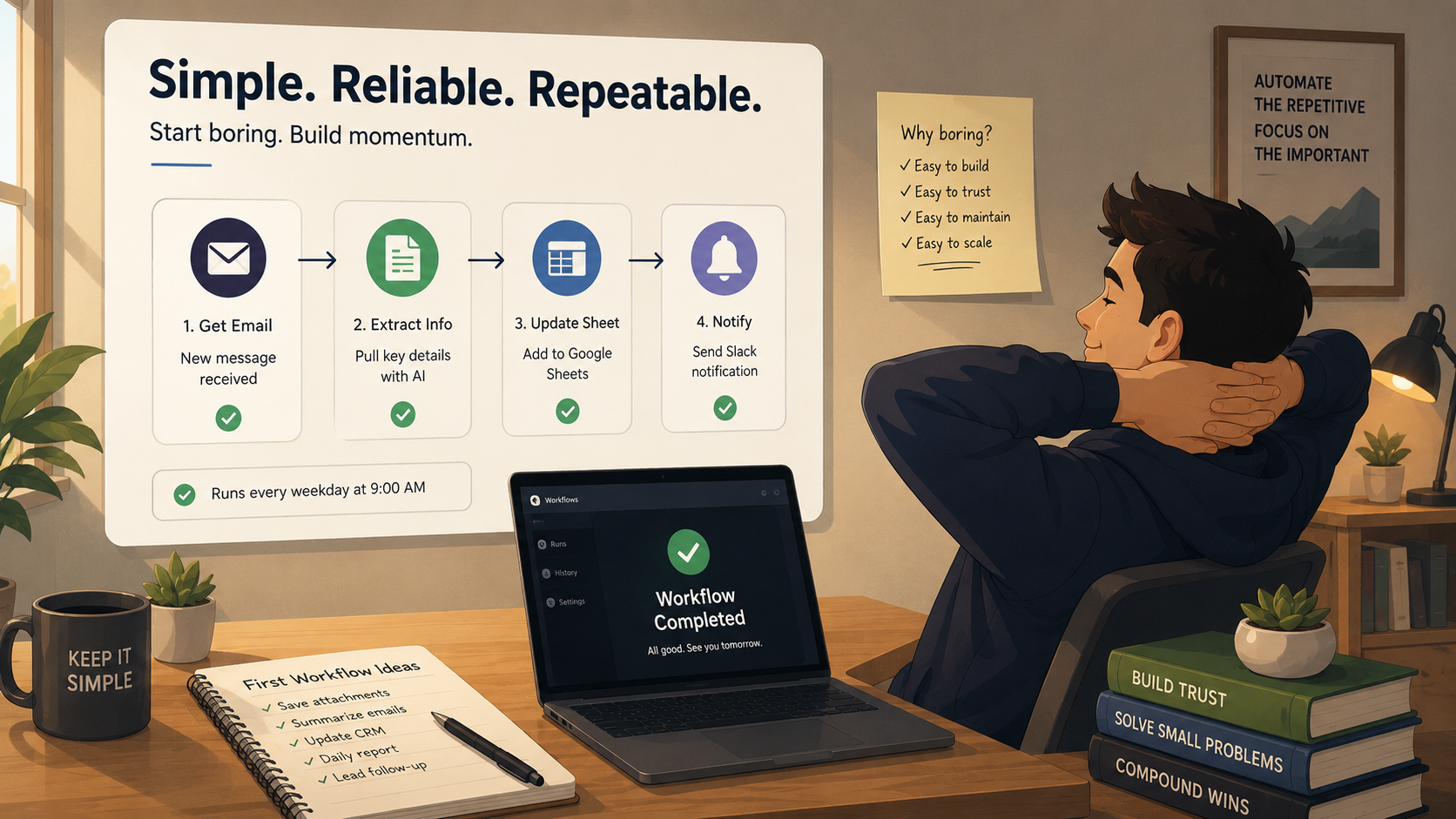
Most teams pick their first AI workflow the way they pick a flagship project. They choose something visible, strategic, and hard. That is usually the wrong move. A boring AI workflow is the safer first production deployment because it is frequent, low-stakes, and easy to check. If it fails, nobody loses a customer, a contract, or trust in the technology.
The first workflow sets the organisational muscle for everything after it. Pick a dramatic one and you spend weeks defending the choice, building review layers, and replaying the one time it sent a weird email. Pick a boring one and you get a quiet, useful habit that compounds. You learn what an AI does well before you bet on what it could do well.
What Counts as a Boring AI Workflow
A boring AI workflow has three properties. It runs often, sometimes many times a day. The stakes are low enough that a mistake is embarrassing, not dangerous. And the output is checkable in under a minute by someone who already understands the task.
- Summarising support tickets into a structured digest for the morning standup.
- Drafting internal release notes from a changelog or pull request list before a human edits.
- Sorting inbound contact form messages into intent buckets (sales, support, spam) for triage.
- Reformatting product copy from one channel template to another for a scheduled post.
- Extracting action items from a meeting transcript into a task list for review.
None of these look impressive on a slide. That is the point. They are the tasks nobody volunteers for, which is exactly why they are under-automated and exactly why an AI can help without threatening anyone’s role. The goal of the first workflow is not to prove AI is powerful. It is to prove AI is reliable enough to trust with something slightly bigger next month.
Why the Dramatic First Workflow Fails
The dramatic first workflow usually comes from a pitch deck, not from operations. A founder sees an AI demo answer a complex customer question and decides the website assistant should go live this quarter. A head of operations watches an agent draft a full Q3 plan and wants planning automation immediately. The problem is not that these are impossible. The problem is that the first deployment is where you discover edge cases, review gaps, and trust thresholds. You want to discover them on a task that costs you five minutes, not five thousand dollars.
The Technology Acceptance Model, a framework researchers have used for decades to explain why tools get adopted, identifies two factors that decide whether people actually use a system: perceived usefulness and perceived ease of use. The dramatic first workflow over-indexes on usefulness (it promises a lot) and under-indexes on ease of use (it is hard to verify, hard to correct, and hard to explain). The boring first workflow is the reverse. Its usefulness is modest but real, and its ease of use is high because the output is small, frequent, and reviewable. People trust what they can check. You can read more about this framework on the Technology Acceptance Model Wikipedia page.
This is also why a pilot, in the formal research sense, exists before a rollout. A pilot experiment is a small, bounded test designed to surface implementation problems before scale. Most teams skip the pilot mindset when the demo looks good. The boring workflow is the pilot. It lets you find your own organisation’s failure modes, review rhythm, and handoff pattern on a task where the cost of finding them is near zero.
How to Pick Yours
Run a short internal audit. List the tasks your team does repeatedly that meet three tests: frequent, low-stakes, and checkable. Then add one more filter: the task should already have a human owner who is not threatened by automation but relieved by it. If the person who currently does the task is excited to hand it off, you have found your boring workflow. If they are defensive, you have picked the wrong first candidate.
A practical prompt for that audit: “What is the task we all avoid, that recurs weekly, and that a junior team member could review in two minutes?” That is your first AI workflow.
What the Boring Workflow Teaches You
The boring workflow is not the destination. It is the training ground. Running it in production for two weeks teaches you four things no demo can:
- Your real review cadence. How often someone actually checks the output, and whether that cadence is sustainable.
- Your correction path. What happens when the output is wrong, and whether the fix reaches the model or just gets silently edited.
- Your trust threshold. The point at which your team stops reading the output carefully and starts assuming it is fine.
- Your handoff shape. Where the AI’s work ends and the human’s work begins, and whether that boundary is clear to both sides.
These four lessons map directly onto the harder workflows you will build later. The customer-facing assistant needs a review cadence, a correction path, a trust threshold, and a handoff shape. So does the planning agent, the pricing agent, and the procurement agent. You want to learn them on a task where the downside of getting them wrong is a slightly awkward morning email, not a customer escalation.
If you have already started down the customer-facing path, a dress rehearsal before the assistant meets a real visitor is the same principle applied at the other end. The boring internal workflow is the rehearsal for your team’s AI operating habits. Both share the same logic: test the boring path before you bet on the dramatic one.
When to Move On
A boring workflow that has run cleanly for two to three weeks, with a human who still checks it but increasingly just approves it, is your signal to pick the next one. Not a dramatic one. A slightly less boring one. Move from summarising tickets to drafting first-response replies for review. Move from sorting contact forms to drafting qualified follow-ups. Move from release notes to a first draft of a customer-facing changelog post. Each step adds one unit of stakes and one unit of visibility.
The team that escalates one notch at a time builds a portfolio of working AI workflows. The team that jumps to the flagship project builds one high-profile failure and a year of internal scepticism. The boring workflow is not a compromise. It is the fastest reliable path to the dramatic one, because it earns the trust that the dramatic one will eventually need.
If you are operationally minded, the same logic applies to who owns the workflow once it is live. A named AI shift lead is what keeps the boring workflow boring, and what turns the next, less boring one into something your team can actually rely on.
The Boring Workflow Is the Strategy
There is a temptation to treat the boring first workflow as a box to tick before the real work begins. It is the real work. The habits it builds, the review cadence it forces, and the trust it earns are the prerequisites for everything ambitious you want AI to do later. Teams that skip it do not save time. They pay the same tuition later, on a much bigger bill.
Pick the dull task. Run it for two weeks. Check the output every time. Then pick the next one. That is how a small team adopts AI without losing control of it, and without convincing anyone that control was ever optional. The boring AI workflow is not the opposite of strategy. It is how strategy becomes reliable.


Leave a Reply