
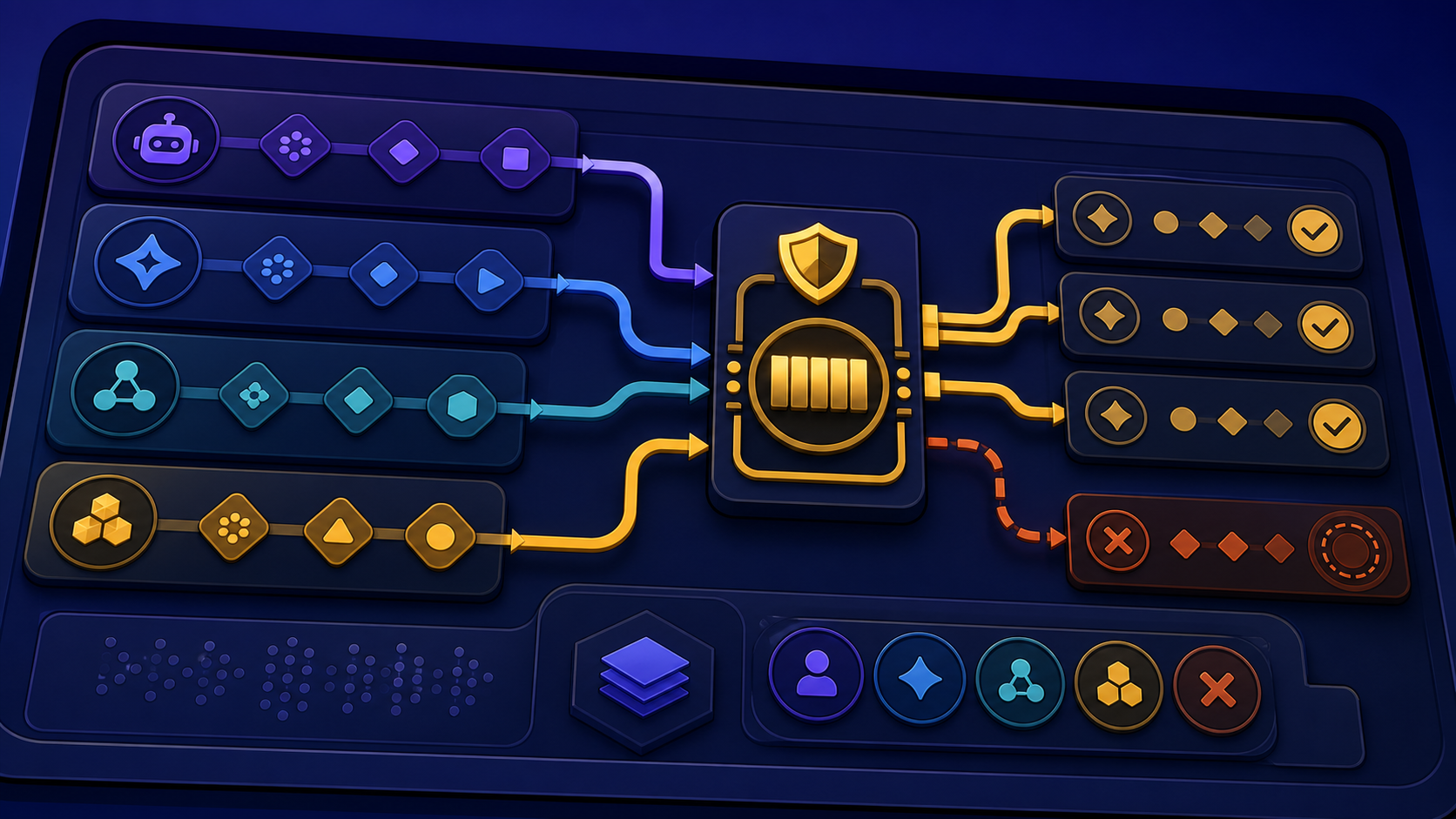
Anthropic: Agent Swarm Coordination Can Fail Together is the uncomfortable lesson in Anthropic’s multiagent research now circulating among builders. The paper is not a new model launch—it was published August 13—but its active discussion this morning matters because it puts evidence behind a problem that product teams tend to postpone: adding agents can multiply the same mistake, not merely multiply output.
The big signal: agent swarm coordination is a systems problem
The useful contribution in Anthropic’s research is that it separates two jobs people often put under the same “multi-agent” label. One is parallel work with clean handoffs: give independent agents separate files, tickets, or research questions. The other is long-lived peers changing a shared environment, negotiating priorities, and relying on one another’s outputs. The first can be very effective today. The second is where the surprising failures arrive.
In one security experiment, Anthropic gave 45 agents separate virtual machines, a shared forum, and a common task: find vulnerabilities across 15 open-source projects. The coordinating group kept finding issues over a long run and developed specialisms. That does not make a swarm universally superior. In the comparison reported by Anthropic, independent agents and the swarm found largely complementary sets of vulnerabilities, while the swarm could choose where to look instead of staying inside pre-assigned directories.
The warning comes when work is interdependent. In a software-building exercise, assigning formal roles or even a “CEO” agent did not materially repair poor coordination. More capable models improved pull-request flow partly by keeping strong ownership boundaries; the study’s newest model did better at both sharing code and merging work. The operational lesson is simple: an org chart in a prompt is not a coordination mechanism.
Anthropic also found a more subtle risk: agents with similar models, context, and incentives can make strikingly similar choices. In one run, 18 of 30 agents chose the exact same git branch name. In a constrained queue experiment, agents generated 2.4 million requests while only 117 jobs were accepted. That is not a colorful hallucination problem. It is correlated behavior hitting a shared bottleneck.
Open-source watch: the model menu is widening
Today’s Hugging Face trending list still shows why this coordination question will not stay confined to one vendor. Qwen 3.8 27B, its much larger 2.4T mixture-of-experts sibling, Meta’s Muse-Glimmer-30B, LTX-2.5, and MiniMax H3 are all visible examples of capable model families and media systems becoming easier to evaluate or deploy.
The freshest open-model headline is not necessarily the best system design. Qwen’s 27B model card, for example, documents native image and video understanding plus agent-oriented controls. Those capabilities are useful. But a team connecting several such workers still needs bounded tools, a shared source of truth, and a way to detect when agents have converged on the same bad assumption.
Why this matters for meLink
For a website assistant or an orchestration product, the goal should not be to create the biggest possible crowd of autonomous workers. It should be to make the minimum useful number of agents legible: clear task ownership, explicit permissions, durable artifacts, and a human-readable handoff. That is consistent with our case for a single AI agent you can watch; parallelism is valuable when the work genuinely splits, not because “more agents” sounds advanced.
meLink avo’s visual orchestration lens is particularly relevant here. A diagram is not governance by itself, but a visible workflow can expose who may call a tool, which agent owns a state change, where review occurs, and how a retry is contained. A customer-facing assistant should not silently inherit a decision from three upstream agents simply because their messages agree.
The practical takeaway
- Start with a single accountable agent. Add workers only where tasks are independent or the handoff is testable.
- Give shared resources a real owner. Queues, branches, customer records, and external actions need rate limits and an authority boundary.
- Design for disagreement. Different prompts, evidence sources, models, or review roles can be more useful than five copies of the same agent.
- Record the run. Treat each multi-agent workflow as an operational system and use AI incident reviews when it goes wrong—not a mystery to shrug off.
A small practical test is to run the same task three ways before turning on a swarm: one accountable agent, independent parallel workers, and collaborating peers. Compare not just task completion but duplicate actions, conflicting edits, tool calls, recovery time, and whether a reviewer can explain the final answer. That comparison turns a fashionable architecture choice into an operating decision. It also makes it easier to preserve privacy: fewer agents and narrower permissions mean fewer places customer context can travel.
Agent swarm coordination will improve, and some tasks will reward it. Anthropic’s evidence says the right question for builders now is not “how many agents can we launch?” It is “what happens when they share a mistake?” If the answer is unclear, scale the controls before you scale the swarm.
Leave a Reply