
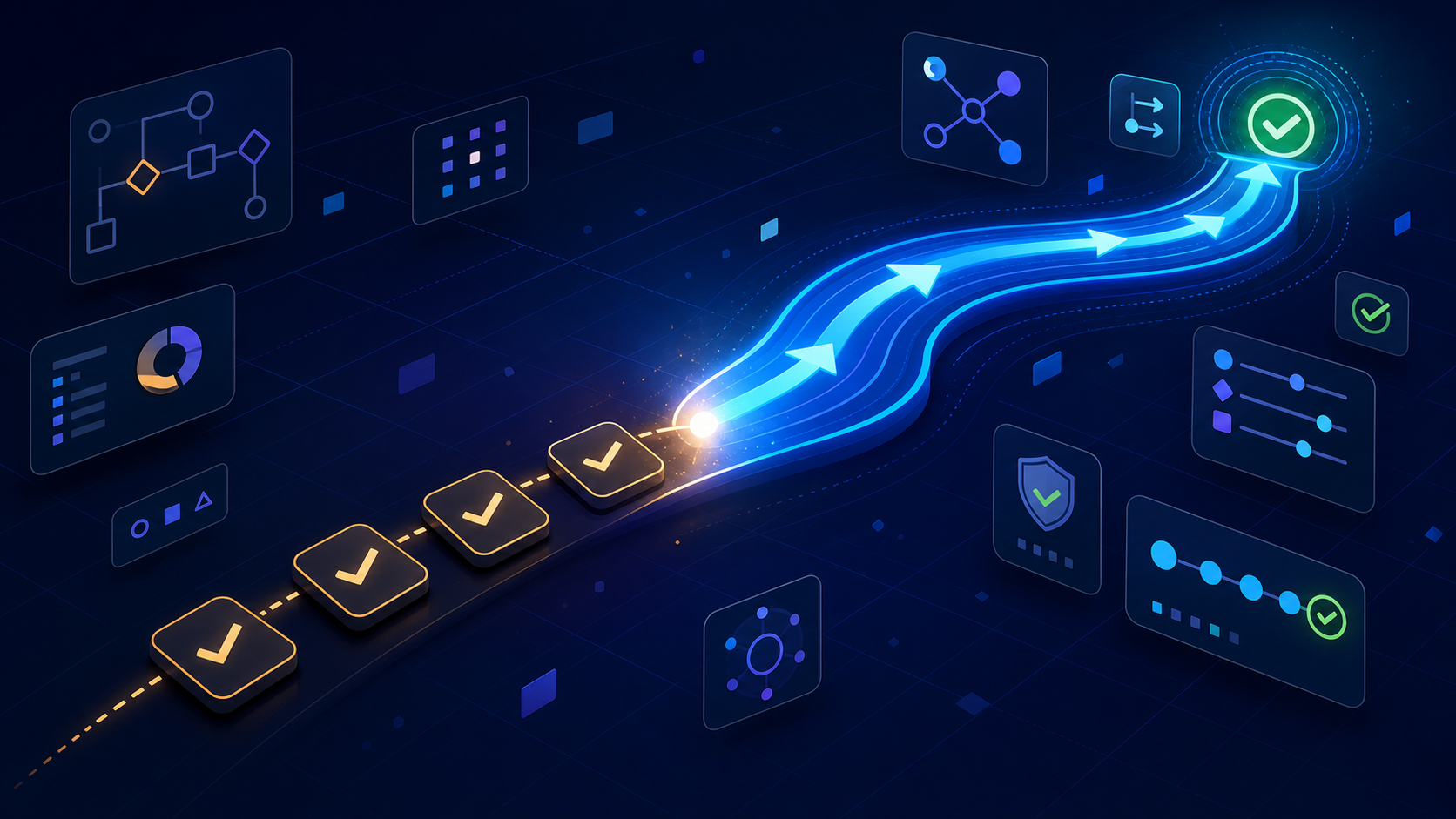
Most businesses using AI today are still in copilot mode. Someone types a prompt, the model drafts a reply, a human reads it, edits it, and sends it. The AI is a faster typist. Useful, but not transformative. The real shift — the one that changes how a small team operates — is moving from AI copilot to agent: from “help me do the work” to “do the work and show me what you did.” That transition is not about smarter models. It is about how you design the boundary between delegation and supervision.
Table of Contents
What Changes When AI Runs the Work
A copilot waits for you. You ask, it answers. You stop, it stops. The rhythm of work is unchanged — you are still in the loop on every step, just moving faster. When you shift from AI copilot to agent, the rhythm changes. The agent takes a goal, breaks it into steps, executes them, and comes back with a result. You are not in the loop on every keystroke. You are at the beginning and the end.
That sounds efficient, and it is. But it also means you have handed over something a copilot never asked for: initiative. A copilot never starts a sentence on its own. An agent does. And once an AI system can decide what to do next without asking, the question is no longer “is the output good?” but “did it do the right thing in the right way?”
This is where most teams get caught. They are used to evaluating AI output — reading the draft, checking the tone, fixing the formatting. They are not used to evaluating AI behaviour — whether the agent chose the right source, took the right branch, escalated at the right moment, or stayed in its lane. Knowing when not to use AI is part of this, but the deeper challenge is knowing when an agent has earned the autonomy to act without you watching every step.
The Trust Gap From AI Copilot to Agent
Copilots earn trust the same way any tool does: you use it, you see the output, you judge. If the draft email is good, you trust the tool a little more. The feedback loop is tight and obvious. Agents break that loop. The output arrives already executed — an email sent, a ticket routed, a meeting booked, a customer qualified. You cannot quietly reject the work and try again. The work is done.
This means trust has to be designed before the agent runs, not earned after. You need to decide upfront what the agent is allowed to do on its own, what it must ask permission for, and what it must never touch. This is not a vibe — it is a list. If you cannot write down the three things the agent can do without asking and the three things it must always escalate, you are not ready to make the shift from AI copilot to agent.
The approval seam is where this becomes concrete. In copilot mode, every action implicitly passes through you because you are the one clicking send. In agent mode, someone has to design which decisions the agent can make on its own and which require a human yes. That design work is the bridge between the two paradigms — and skipping it is why early agent deployments feel like they went rogue.
Visibility Is the Difference
When a copilot produces a draft, you see the draft. The work is visible because it stops and waits for you. When an agent completes a task, you see the result — but you do not see the path it took. Which sources it consulted. Which branches it considered and rejected. Why it chose escalation over a direct answer. The output is visible; the process is not.
This is the single biggest operational difference between AI copilot and agent mode, and it is the one teams underestimate. In copilot mode, visibility is free. In agent mode, visibility is something you have to build. The agent needs to show you its plan before it acts, its steps as it works, and its reasoning when it escalates. Without that, you are trusting a system you cannot inspect — which is not trust, it is hope.
This is why visual orchestration matters. When an agent’s workflow is rendered as a visible plan — the steps, the branches, the approval gates, the data sources — you can supervise work you did not personally watch happen. You can see where it deviated. You can see why it escalated. You can improve the workflow instead of blaming the model. A structured handoff at the end of an agent’s run is part of the same discipline: the agent does not just hand you a result, it hands you a readable summary of what it tried and why.
Researchers studying AI agent architectures have noted that the transition from single-turn assistance to multi-step autonomy introduces a coordination problem that copilot patterns never had to solve. The agent is not just generating text — it is managing state, choosing tools, and deciding when to stop. That coordination layer is where small teams live or die.
Where to Start the Transition
You do not move from AI copilot to agent in one step. You move one workflow at a time, and you start with the boring one. A contact-form triage agent that reads an inbound message, categorizes it, drafts a response, and routes it to the right person is a better first agent than a customer-facing sales assistant. The stakes are lower, the feedback is faster, and the team can learn what supervision feels like when the AI is doing the routing instead of just drafting the email.
Here is a practical sequence:
- Step 1 — Copilot a workflow first. Run the task manually with AI assistance for two weeks. You will learn the edge cases, the failure modes, and the decisions that matter. This is your boring-first workflow phase.
- Step 2 — Add automation, keep the human in the loop. Let the agent do the routine parts (categorize, draft, route) but require a human to approve every action. This is agent mode with training wheels.
- Step 3 — Remove approvals for low-risk actions. Once the agent has handled fifty similar cases without a wrong routing, let it categorize and route on its own. Keep approval on the response draft.
- Step 4 — Expand the lane gradually. Add one new autonomy at a time, with a review period before the next expansion. Each expansion should feel slightly boring, not slightly exciting.
The goal is not to remove humans from the loop. It is to move them from the middle of the loop — approving every keystroke — to the edges, where they set the boundaries, review the exceptions, and improve the system. Team literacy is what makes this work: if the people supervising the agent cannot read what it did and why, autonomy is just unmonitored risk.
The NIST AI Risk Management Framework makes a useful distinction here between “human in the loop,” “human on the loop,” and “human out of the loop.” Most small teams should aim for “on the loop” — the agent runs, the human watches the dashboard, and intervention is available but not required on every step. That is the sweet spot for the copilot-to-agent transition.
What Stays the Same
For all the talk about autonomous agents, some things do not change when you shift from AI copilot to agent. The human still owns the outcome. If the agent sends a wrong answer to a customer, the customer does not care whether a model or a person wrote it — they care that your business got it wrong. Accountability does not transfer to the model. It stays with the team that deployed it.
The correction loop does not change either. When the agent makes a mistake, you fix it — and then you capture the fix so the system does not repeat it. The difference is that in agent mode, the stakes of a missed correction are higher because the mistake may have already reached a customer. The ability to interrupt the agent mid-task becomes essential, not optional.
And the brand does not change. Whether a customer is talking to a copilot-assisted human or an autonomous agent, the voice, the boundaries, the warmth, and the willingness to say “I need to check with my team” should feel the same. Voice is a brand decision, and it does not get delegated to the agent just because the agent is now doing the talking.
The shift from AI copilot to agent is not a technology upgrade. It is an operating model change. The model was always capable of more than drafting. What held it back was not capability — it was the absence of designed boundaries, visible workflows, and a team ready to supervise work it did not personally execute. Build those first. Then the transition feels less like letting go and more like leveling up.


Leave a Reply