
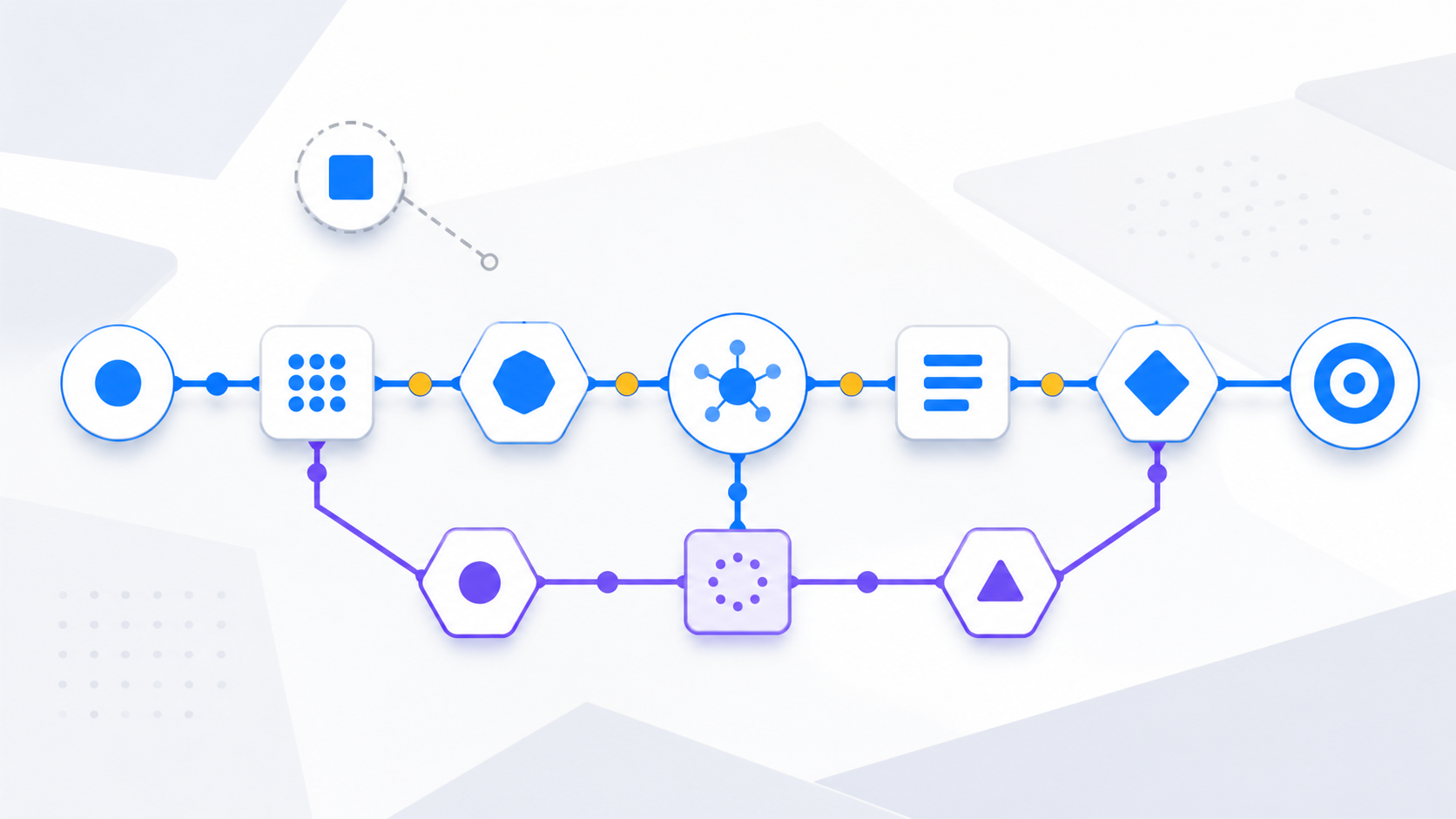
An AI dependency map is the fastest way to turn a clever agent demo into an honest service. It shows every thing a useful answer or action relies on: the model, approved knowledge, identity and permissions, connected tools, a human owner, and the fallback when one of those pieces is unavailable. Without that map, a small outage can become an unexplained customer promise.
Table of Contents
The hidden system behind an agent
When an assistant gives a good answer, it is tempting to credit the model. But the useful outcome usually came from a chain around the model: a current price page, a connected calendar, an authentication token, a routing rule, and someone who can take over if the request crosses a line. The model is visible; the chain is not.
That invisibility is costly. A knowledge source may be updated without the assistant seeing it. A CRM permission may expire. A booking integration may be slow. A vendor may change a response format. None of those events is dramatic on its own. Together, they can turn a straightforward visitor question into a confident answer with no reliable basis.
This is why an AI dependency map is not an enterprise architecture exercise. It is a service-design artifact for the people who own a real customer lane. The map asks a practical question: “What must be true for this agent to be useful and safe right now?”
Build an AI dependency map around one lane
Start smaller than the whole business. Choose one recurring outcome, such as answering website questions about a standard product plan or turning contact requests into a morning sales queue. Draw the path from incoming question to useful next step. An AI dependency map for that lane needs only six labels:
- Job: the outcome the assistant is allowed to produce.
- Evidence: the approved pages, catalogue records, or policy sources it may use.
- Systems: the model, retrieval layer, CRM, calendar, email, or other connected tools.
- Authority: the exact permissions and actions available in the lane.
- Owner: the person who can decide whether the lane still tells the truth.
- Fallback: what the customer and team experience when a dependency is missing, stale, or unavailable.
Notice what this is not: a catalogue of every app the company owns. A good map is bounded by one job. That discipline complements an AI context budget: the agent should receive only the evidence it needs for the task, and the team should know exactly where that evidence comes from.
For a website assistant, the map might show public product information flowing into direct answers; a booking tool that is used only after a visitor asks to meet; and a sales owner who receives anything involving bespoke scope, contractual terms, or a promise not grounded in approved material. If the booking tool is unavailable, the fallback is not a fake confirmation. It is a clear acknowledgement and a structured request for the human team.
Give every dependency an honest fallback
The value of an AI dependency map appears when something is not working. Each box on the map should have a named behaviour for three states: healthy, degraded, and unavailable. “Degraded” matters because systems rarely fail as a clean on/off switch. A source can be late, incomplete, or contradictory; a tool can return partial data; an identity service can permit reading but not writing.
Healthy can mean “answer from the approved product page.” Degraded can mean “state that current confirmation is needed and offer a human route.” Unavailable can mean “do not attempt the action; preserve the request and explain the next step.” Those choices prevent the worst recovery pattern: an agent inventing a plausible result because the real system did not answer.
There is useful precedent here outside AI. The NIST Cybersecurity Framework treats the identification of assets, dependencies, and responsibilities as a foundation for managing risk. And the Google SRE guidance on cascading failures is a reminder that connected systems need deliberate boundaries rather than blind retries. An agentic workflow is also a connected system; it deserves the same respect for failure modes.
That does not mean adding bureaucracy. It means deciding, before a dependency breaks, whether the agent can wait, ask, route, or stop. The failure demo you request from an AI vendor becomes more useful when you can point to the exact dependency and fallback that the demo must exercise.
Make the map a small operating habit
An AI dependency map should fit on one page and change when the lane changes. Review it when a source is replaced, a new tool is connected, permissions expand, or the human owner changes. A ten-minute check is enough: What changed? Which outcome now depends on it? What will the agent do if it is late or gone? Who will notice first?
This is also a better conversation with investors and partners than “we use a powerful model.” It shows that the team understands where value is actually delivered: in a dependable route from customer intent to a truthful next step. Models will change. Connected services will change. A clear map makes those changes manageable instead of mysterious.
Don’t ask whether your agent has access. Ask whether you can draw the chain of trust that makes its answer safe to use.
That is the quiet advantage of mapping dependencies. It gives a small team permission to build ambitious coverage without pretending the system is simpler than it is. You can see the bridge, name the weak points, and keep a human route ready. You’ve got this.


Leave a Reply