
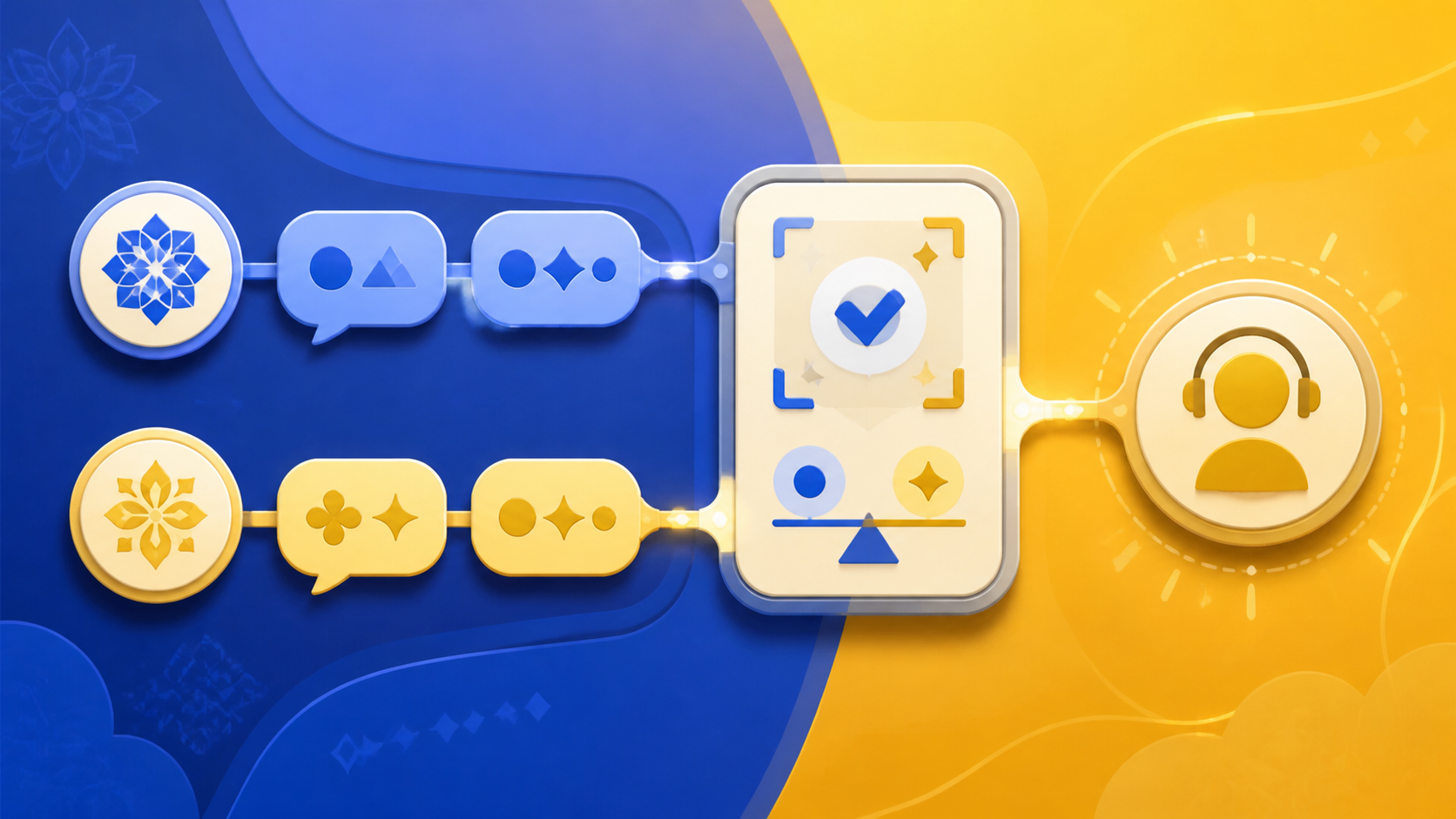
Launching an assistant in a new market can look deceptively simple: translate the interface, point it at the same knowledge base, and switch it on. But language carries expectations about directness, certainty, privacy, and when a person should step in. An AI localization review is how a business checks those expectations before a fluent answer becomes an expensive misunderstanding.
Table of Contents
Translation is not the job
A translated sentence can be grammatically perfect and still make the wrong promise. “We can help with that” may sound like a warm acknowledgement in one setting and a commitment in another. A friendly, informal sales voice may build trust with one audience and feel careless with another. An assistant that says it will “follow up soon” without a locally credible response window creates the same problem in every language: it leaves the customer holding a promise nobody owns.
This is why localization belongs to product design, not the last pass before launch. The W3C Internationalization guidance makes a useful distinction: international-ready products account for language and cultural variation in the design itself. For an AI assistant, that means examining the conversation, its evidence, and its exits—not merely its words.
The same principle applies to voice. A team that has already treated an AI assistant’s voice as a brand decision has a head start: voice is not a layer of polish. It shapes how customers interpret confidence, apology, urgency, and a boundary. In a new market, those interpretations deserve deliberate review rather than a model’s best guess.
Run an AI localization review on real conversations
A useful AI localization review is small enough to run before a launch and concrete enough to expose awkward assumptions. Do not begin with a document full of generic translated answers. Begin with fifteen to twenty conversations that resemble the work your assistant will actually see: a straightforward product question, a pricing edge case, an impatient follow-up, a privacy concern, a request outside the assistant’s lane, and an ambiguous message.
- Meaning: Does the answer preserve the customer’s intent and the company’s intended promise?
- Expectation: Does its tone set the right level of certainty, speed, and formality for this market?
- Evidence: Are prices, availability, policies, and claims still grounded in the right local source?
- Exit: When the assistant cannot safely answer, does it offer a clear route to a person rather than a vague apology?
Give this review to people who know the market as well as the product. The best reviewer is rarely only a translator or only an engineer. It is someone who can say, “That phrase technically works, but a customer will hear it as a guarantee,” and someone who can change the workflow when that guarantee is not supportable.
There is a practical accessibility benefit too. Clear language, predictable choices, and an available human alternative help many kinds of customers, not only people in a new locale. AI accessibility as a product requirement is a useful companion discipline: ask whether the interaction gives people more than one usable path through a conversation.
For broader product teams, the Nielsen Norman Group’s guidance on language and locale is a good reminder that locale is bigger than translated copy. Dates, names, money, examples, interaction patterns, and social expectations all affect whether an experience feels trustworthy.
Design the local human route
Localization reveals an uncomfortable truth: the hard part is often not producing another language. It is deciding who can take responsibility when the assistant should stop. If a visitor asks for a custom contract, a regulated claim, or a region-specific exception, the right answer may be a handoff. That handoff has to work in the visitor’s time zone, with a realistic expectation of what happens next.
Make the route explicit. Name the team or inbox. State the likely next step without inventing a deadline. Preserve the customer’s question and the evidence the assistant used, but do not dump a long transcript on the human. The point is continuity: a person should be able to pick up the conversation without making the customer repeat themselves.
This is where an AI localization review earns its keep. It tests whether the “human in the loop” is real in the market you are entering—not just a comforting phrase in the English-language prototype. A regional sales team may need different working hours, authority boundaries, or source material. That is product work, operational work, and customer trust work at once.
Start with one market and one promise
Do not try to localize every assistant capability at once. Choose one market and one consequential promise: answering implementation questions, qualifying a website inquiry, or explaining a plan. Run the cases, correct the evidence, tune the tone, and rehearse the human route. Then record what changed so the next market starts with a stronger system rather than a fresh translation exercise.
Keep a short record of the cases that changed during review. A phrase that sounded too absolute, a source that did not apply locally, and a handoff that lacked an owner are not translation defects to hide. They are reusable product decisions. When the next language or region arrives, those decisions become a practical starting set instead of institutional memory scattered across a launch chat.
The goal is not for an assistant to sound native at any cost. It is for a customer to understand what is true, what will happen next, and when a real person is responsible. That is the standard for an AI localization review: not fluent output, but a trustworthy conversation that travels well.


Leave a Reply