
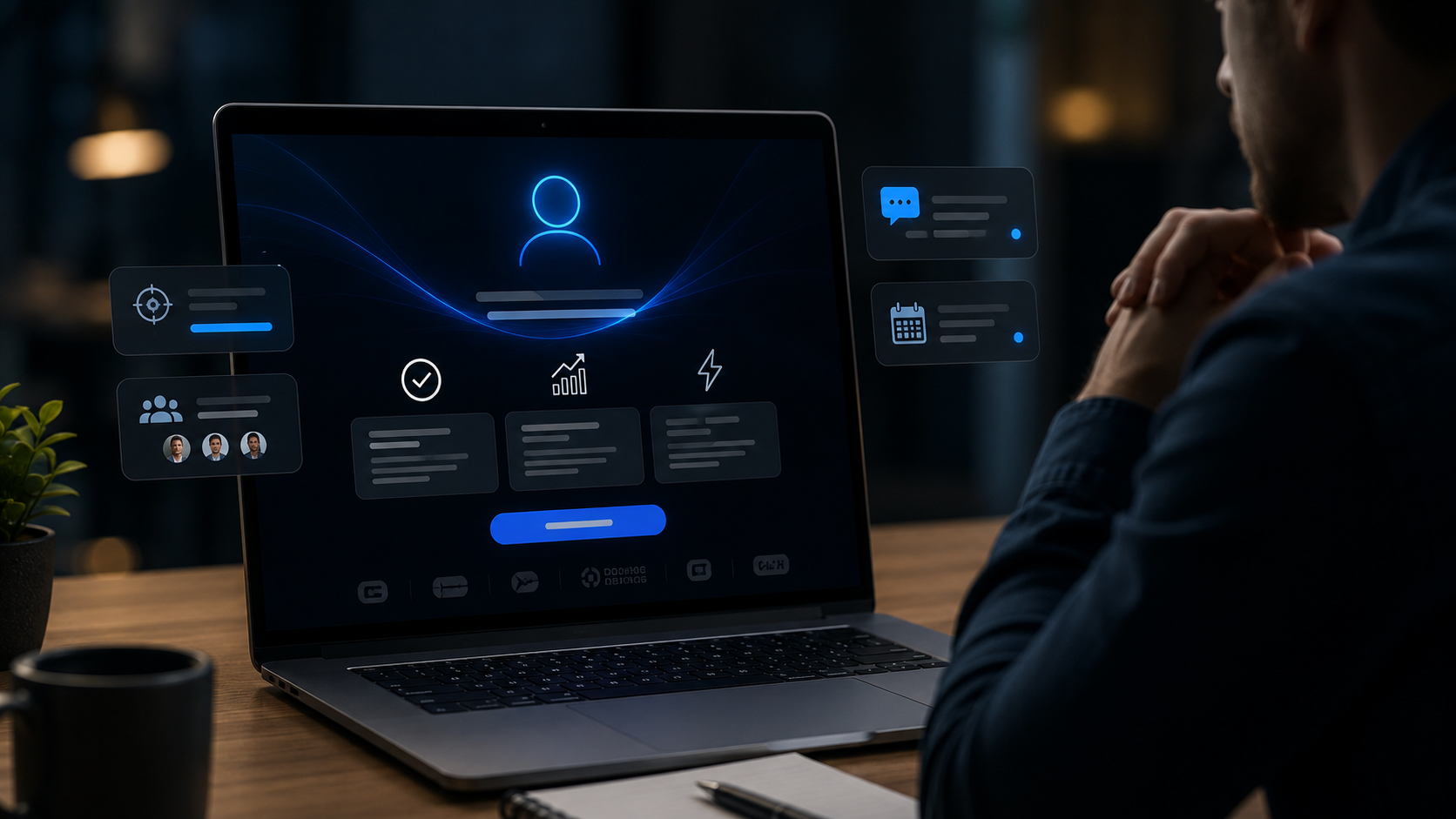
Most business websites close at 5pm. Not officially — nobody flips a sign. But the moment your last salesperson logs off, your site becomes a brochure that nobody’s reading aloud. Visitors still arrive. Questions still get asked. They just don’t get answered until morning, by which point they’ve already visited three competitors.
Here’s the part that doesn’t get talked about enough: your website is usually the first sales conversation a prospect has with your company. Not the demo call. Not the discovery meeting. The website. And most businesses are routing that first call straight to voicemail.
The 11pm visitor is already a qualified lead
Think about who visits a B2B website at 11pm on a Tuesday. It’s not a casual browser. It’s a founder, an operations lead, a procurement manager — someone with a real problem who finally has a quiet moment to research it. They’ve got intent. They’ve got budget authority, or at least influence. They’re three tabs deep into comparing vendors.
What happens when they land on your site? They read the homepage. They maybe open the pricing page. They have a question that the FAQ doesn’t quite answer — something specific to their industry, their stack, their compliance situation. There’s no one to ask. The chat widget, if you have one, says “We’ll get back to you during business hours.” They close the tab. The lead is gone, and your analytics will never tell you it happened.
You don’t lose this visitor because your product is worse. You lose them because nobody was there.
Your website is a sales call that never ends
The mental model most businesses hold is: the website is the brochure, the sales team is the conversation. That’s backwards. The website is the conversation — it’s just one that’s been running 24/7 since you launched it, and you’ve been leaving it unsupervised for 16 hours a day.
Always-on website coverage means treating the site like a salesperson who never clocks out — but, crucially, one who knows when to escalate. It’s not a chatbot that pretends to be human. It’s a coverage layer that can qualify, answer the questions a competent salesperson would answer in the first five minutes, route the ones that need a human, and remember what was said so the morning team picks up mid-conversation rather than from scratch.
What coverage actually does
A real salesperson on a first call does four things. A coverage layer should do the same four:
- Qualify. Is this visitor in scope? Are they the right size, right industry, right stage? A good salesperson asks two or three sharp questions in the first minute. A coverage layer can do the same — gently, without a form that feels like an interrogation.
- Answer. The repetitive questions — pricing tiers, integrations, security posture, deployment options — these are the ones a salesperson answers fifteen times a week and could hand off without losing anything. An always-on coverage layer handles them at 11pm the same way it handles them at noon.
- Route. When the question is specific — “we’re a HIPAA-covered clinic, can your platform handle X?” — the right move isn’t to guess. It’s to capture the context cleanly and route it to the person who can answer properly. Coverage isn’t about never escalating. It’s about escalating with context.
- Remember. The visitor who came back at 11pm and returns at 9am shouldn’t have to reintroduce themselves. The morning salesperson shouldn’t start from zero. Coverage that remembers the thread turns two fragmented visits into one continuous conversation.
Coverage is not a chatbot
Most businesses that tried “AI on the website” in the last two years installed a chatbot, watched it hallucinate a refund policy or confidently misquote a price, and concluded the technology wasn’t ready. Fair reaction. But the problem wasn’t the model. The problem was the framing.
A chatbot is a thing visitors talk to. Coverage is a thing that watches, helps, and hands off. The distinction matters because it changes what you measure. A chatbot is measured by how long someone talks to it. Coverage is measured by how many useful conversations get completed — and how many of them would have been lost entirely without it.
The businesses getting this right aren’t the ones with the fanciest model. They’re the ones who mapped the fifteen questions their sales team answers every week, gave the coverage layer those answers with explicit boundaries (“if the question goes beyond this, escalate”), and treated the morning handoff as the real product — not the after-hours chat.
The gap nobody measures
Here’s a simple exercise. Pull your website analytics for the last 30 days. Look at the traffic that arrived outside business hours — evenings, weekends, early mornings. Now look at your conversion rate for that segment versus the segment that arrived during business hours, when someone could respond within minutes.
Most businesses find a gap. Not a small one. The after-hours traffic is often a third to half of total visits, and it converts at a fraction of the rate. That gap isn’t a marketing problem. It’s a coverage problem. Those visitors were interested enough to show up. Nobody was there to meet them.
Start with the handoff, not the bot
If you’re thinking about adding coverage to your site, the instinct is to start with the AI — what model, what prompt, what tone. Resist that. Start with the handoff. What does your morning team need to receive to pick up the conversation without friction? A name, a company, what they were looking at, the question they asked, and where it got stuck. If the handoff is clean, the coverage layer can be modest and still be valuable. If the handoff is broken, the smartest model in the world won’t save you.
The goal isn’t a website that never needs humans. It’s a website that never wastes the humans you have — and never leaves a ready buyer talking to an empty room.
You’ve got this
The first sales call has already happened. It happens every evening, every weekend, every time someone lands on your homepage with a question and a deadline. The only question is whether anyone’s there to take it. Coverage doesn’t mean replacing your sales team. It means the first conversation — the one your team never sees — finally gets answered.


Leave a Reply