
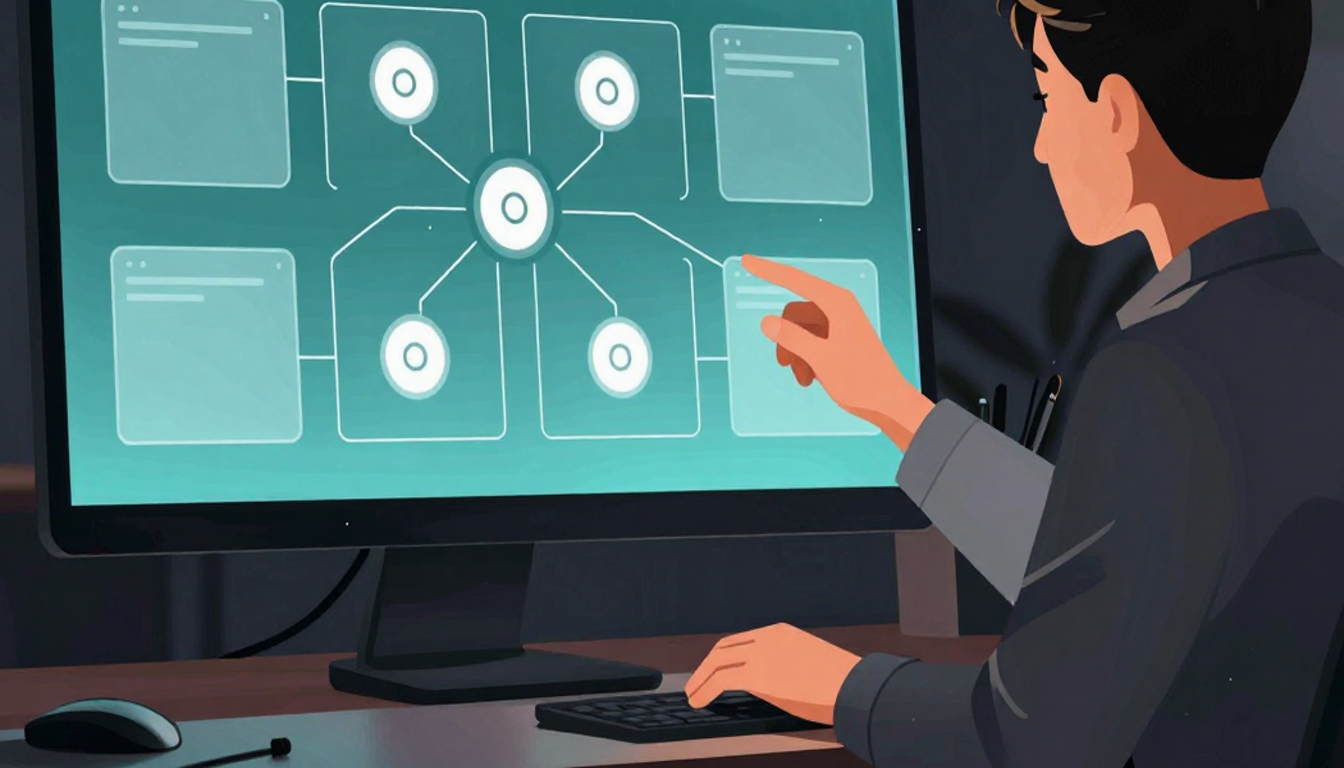
Most business websites are built for office hours.
They explain the offer. They show the proof. They make the company look credible. Then, at the moment a buyer has a specific question, they ask that person to fill in a form and wait.
That made sense when a website was mostly a brochure. It makes less sense now. Buyers do more of their own research. Teams are stretched. Attention is fragile. A serious lead might arrive at 10:47 at night, compare three tabs, wonder whether your service fits their edge case, and disappear before anyone sees the notification.
The answer is not to bolt a generic chatbot onto the corner of the page and hope for magic. The better framing is simpler: your website needs a closing shift.
A closing shift is not a replacement for sales
In a physical shop, the closing shift does not reinvent the business. It keeps the lights on, answers the last questions, notices intent, tidies up the handover, and makes sure no good opportunity is lost because the right person was not standing there at the right second.
That is the useful mental model for AI on a business website. Not “let the bot run the company”. Not “automate relationships”. Not “replace the team”. Website AI should cover the moments where visitors need clarity and the team needs context.
The difference matters. A chatbot is usually judged by whether it can talk. A closing shift is judged by whether it helps the business handle interest better.
The hidden leak is not traffic. It is uncertainty.
Many teams treat website performance as a traffic problem. More visitors, more campaigns, more content, more retargeting. Sometimes that is right. But a surprising amount of lost demand is not caused by too few people arriving. It is caused by people arriving with just enough uncertainty to do nothing.
They want to know whether you serve their industry. Whether pricing starts in their range. Whether integration is realistic. Whether the product is for small teams or enterprises. Whether the privacy posture is good enough. Whether the company understands their kind of problem.
Those are not always big questions. They are often small, practical, slightly awkward questions. The kind people may not want to put into a form. The kind that are easy for a knowledgeable person to answer in thirty seconds, but expensive to miss.
This is where a well-designed website assistant can be valuable. It gives the visitor a way to reduce uncertainty while the intent is still warm. It also gives the business a clearer picture of what visitors are actually trying to understand.
Coverage beats cleverness
The best website assistant does not need to sound impressive. It needs to be present, grounded, and honest.
- Present enough to respond when the team is busy or offline.
- Grounded enough to answer from the actual business context, not a vague model memory.
- Honest enough to say when something needs a human, a quote, or a follow-up.
That is a different design standard from the usual demo. Demos reward fluency. Businesses should reward reliability.
A visitor asking “Can this work for a multi-location service company?” does not need a theatrical answer. They need a clear response, maybe a relevant example, and a path to the next step. If the assistant cannot answer safely, it should collect the context and route it properly.
The handover is the product moment
The quality of a website assistant is often revealed after the conversation, not during it.
Did it capture the visitor’s actual need, or just their email address? Did it separate a support question from a sales opportunity? Did it record the objections that came up? Did it give the team enough context to respond like they had been paying attention?
A weak handover creates a strange experience. The visitor has already explained themselves to the assistant, then has to explain everything again to the team. That makes the AI feel like decoration.
A strong handover does the opposite. It makes the business feel more joined up. The human reply can be warmer, faster, and more specific because the assistant has done the listening work without pretending to own the relationship.
For operators, this is where the return often shows up. Not in a fantasy of total automation, but in fewer dropped leads, cleaner follow-ups, better routing, and a growing map of what buyers keep asking before they trust you.
Privacy is part of the sales experience
There is another reason to think carefully about website AI: the conversation can become sensitive very quickly.
A buyer might describe internal workflows, budgets, customer issues, health concerns, legal constraints, or competitive worries. Even when the initial question looks simple, the context behind it can be private.
That means privacy is not a policy-page afterthought. It is part of the trust experience. Visitors should not feel like they are feeding a mysterious black box. Businesses should know what is logged, where it goes, how long it is retained, and which information should trigger a human-controlled path.
This is also where local-first and hybrid AI choices become practical rather than ideological. Some answers can be handled with lightweight cloud models. Some knowledge should stay tightly scoped. Some workflows may justify local processing, stricter retention, or explicit approval before anything leaves the business environment.
The point is not to make every company run its own AI stack. The point is to make the architecture match the trust level of the conversation.
What to give your website assistant before you give it autonomy
The practical setup work is less glamorous than the AI demo, but it is what makes the system useful.
- Clear boundaries: what it may answer, what it must not promise, and when it should escalate.
- Current knowledge: product pages, pricing guidance, service areas, FAQs, case notes, and the actual language the business uses.
- Good questions: the few qualifying prompts that help the team respond well without making the visitor feel interrogated.
- Routing rules: who gets sales leads, support issues, partnership requests, complaints, and high-value opportunities.
- A review loop: a way to learn from conversations, improve answers, and spot gaps in the website itself.
Notice what is missing from that list: “make it sound like a genius”. Tone matters, but usefulness matters more. A calm assistant with the right boundaries will beat a charming assistant that overpromises.
The website becomes a learning surface
One of the underrated benefits of an AI-assisted website is that it can show you what your content is failing to explain.
If visitors keep asking the same question, that is not just a support burden. It is a product signal. It may mean the page is unclear, the offer is too abstract, the pricing language is too hidden, or the next step is too vague.
In that sense, the assistant is not only a front-door tool. It is a feedback instrument. It helps the team see the gap between the story they think the website tells and the story visitors are actually receiving.
That is especially useful for small teams. You may not have a full-time conversion researcher, sales operations analyst, and support triage function. But you can still build a loop where real questions improve the website, the offer, and the handover process.
A better question for founders
The question is not “Should we add AI to the website?” That is too broad, and it invites gimmicks.
A better question is: “Where are interested people getting stuck when nobody is there to help?”
Start there. Map the moments of uncertainty. Decide what should be answered instantly, what should be captured carefully, and what should be handed to a human. Build the assistant around coverage, trust, and clean next steps.
That is how website AI becomes more than a widget. It becomes a practical layer of business presence: always on, but not out of control; helpful, but not pretending to be human; automated, but designed around the people who still carry the relationship.
Your website does not need to become louder. It needs to become more available at the moments that matter.
You’ve got this.

Leave a Reply