
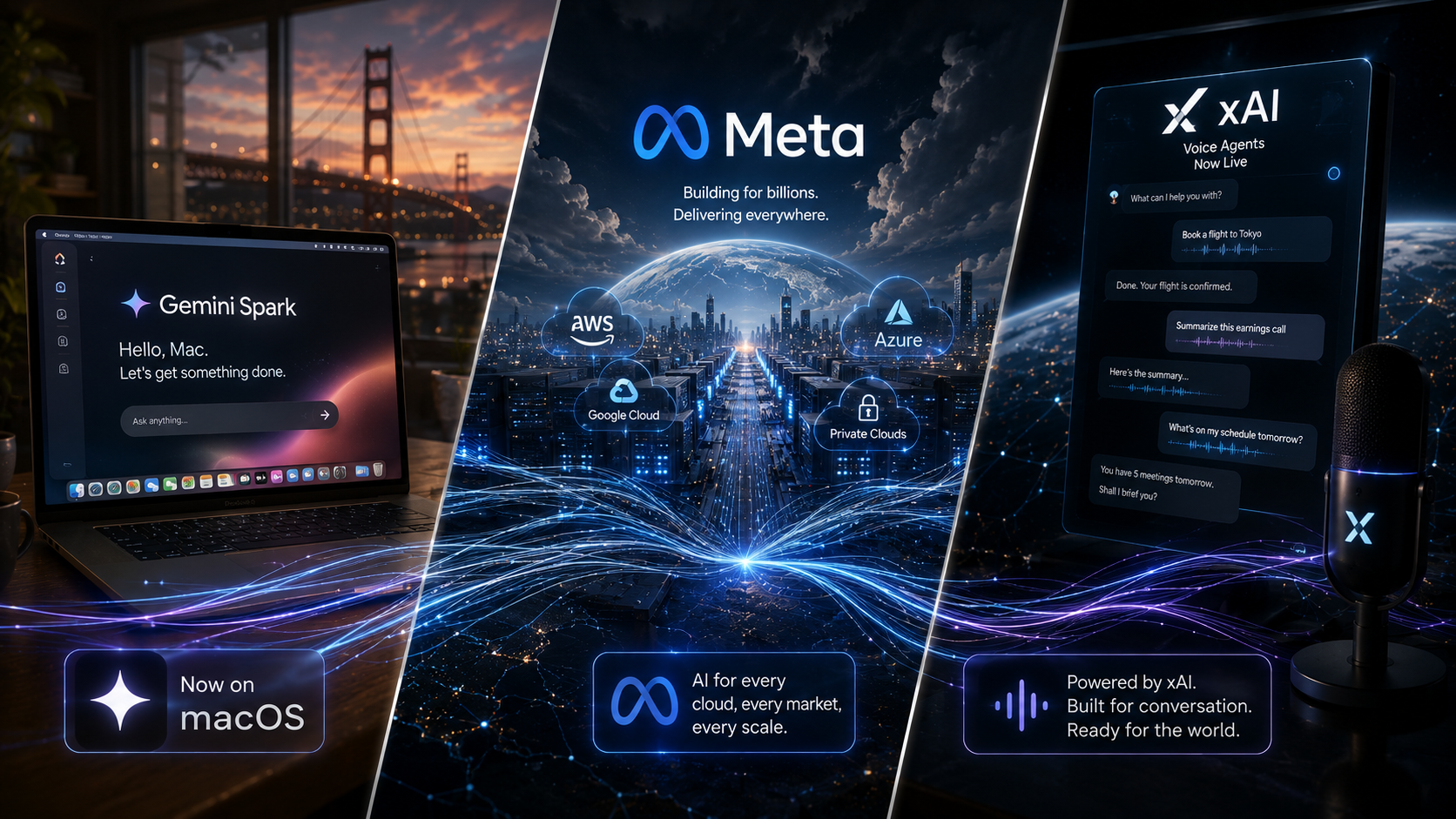
July 1 was a day when the AI industry’s biggest players stopped competing on model benchmarks and started competing on reach. Google put Gemini Spark on macOS with local file access. Meta decided to become a cloud company. xAI shipped a no-code voice agent builder. And a privacy-first AI startup called Venice quietly became a unicorn. The throughline is no longer “who has the smartest model” — it is “who can put an agent closest to your work, your files, and your voice.”
For builders, investors, and anyone watching practical AI adoption, the shift matters. The frontier model race is not over, but the differentiation is increasingly about distribution, integration, and infrastructure — not raw IQ.
The big signal: Gemini Spark lands on macOS with local file automation
The most consequential single move yesterday was Google bringing Gemini Spark to macOS. Spark, the proactive agentic assistant Google introduced at I/O 2026, now lives inside the Gemini desktop app with a dedicated sidebar tab. It can read your local files — but only the folders you explicitly approve — and act on them.
That sounds simple, but it is the first time a major frontier lab’s agentic assistant has been given direct, persistent access to a desktop filesystem at scale. Spark can sort PDFs in your Downloads folder, pull figures from saved invoices, build a Google Sheets budget from those invoices, and schedule recurring updates to that spreadsheet. The Mac Observer and Neowin both confirmed the details: you grant folder access, Spark works within those boundaries, and you can revoke access at any time.
Google also announced that a future update will let you trigger Mac tasks remotely from your phone — assign a multi-step job while you are away, and Spark executes it on your machine. That is a meaningful step beyond what cloud-only assistants can do. An agent that can find a sales report on your Mac, extract the revenue number, and email it to you while you are in a meeting is a different category of tool than a chatbot.
Spark also gained deeper integrations: Google Tasks and Keep on the first-party side, plus Canva, Dropbox, Instacart, OpenTable, and Zillow Rentals on the third-party side. Custom MCP (Model Context Protocol) server support is now available, which means developers can wire Spark into their own systems. Real-time topic monitoring lets the agent track sports, weather, finance, shopping, and blogs, and react to events as they happen.
The catch: it requires a Google AI Ultra subscription at $100 per month, is limited to the US, English, and users 18+, and remains in beta. But the pattern is clear. Google is building an always-on agent layer that lives across your devices, reads your files, talks to your apps, and monitors your world. That is the product frontier now.
Meta becomes an AI cloud provider
While Google was putting agents on desktops, Meta was making a move that shook the AI infrastructure market. Bloomberg reported that Meta is building a cloud business to sell its excess AI computing power — and Meta’s stock jumped roughly 9% on the news.
The strategic logic is sharp. Meta has built one of the largest GPU fleets in the world to train its models. But inference demand is uneven, training runs have gaps, and not every GPU is hot at every hour. Selling spare capacity turns a fixed cost into a revenue line. It also puts Meta in direct competition with CoreWeave and Nebius, whose shares tumbled on the announcement.
The backdrop matters. Weeks ago, Google was forced to ration Meta’s access to Gemini because it could not meet the compute demand. Meta learned the hard way that depending on someone else’s cloud for frontier inference is a fragile position. Now it is pivoting to become both a consumer and a provider of AI compute — a vertical integration play that mirrors what xAI has already done by renting out its own capacity.
xAI ships Voice Agent Builder
Elon Musk’s xAI made a quieter but notable move: it launched Voice Agent Builder in beta, a no-code tool for creating voice-based AI agents powered by Grok. The product targets developers and businesses that want to build conversational voice agents without writing infrastructure code, with per-minute pricing.
Voice is an undertold frontier in agentic AI. Text-based agents have dominated the conversation, but voice agents are where the rubber meets the road for customer service, phone-based workflows, and hands-free enterprise use cases. xAI’s entry means every major frontier lab now has a voice play — Google with Gemini Omni, OpenAI with its voice features, Anthropic with Claude’s voice modes, and now xAI with a dedicated builder tool.
SpaceX AI device: real or noise?
The WSJ reported that SpaceX showed investors a prototype of a new AI device — described as “thinner than an iPhone” and powered by xAI’s Grok technology. Musk denied the report. The Decoder and TechCrunch both noted the device sounds phone-ish, though its exact form factor remains unclear. Treat this as unconfirmed for now, but the signal is worth tracking: Musk’s companies are clearly thinking about dedicated AI hardware, and the SpaceX IPO timeline adds pressure to show product narratives beyond rockets.
Open-source watch
Kimi K2.7 Code hits GitHub Copilot. Moonshot AI’s open-weight coding model is now generally available in GitHub Copilot. This is a meaningful signal: GitHub’s multi-model strategy now extends to a Chinese open-weight model, sitting alongside Claude and GPT. For developers, it means more choice in coding assistants and proof that open-weight models from outside the US are reaching production-grade distribution channels.
Venice AI becomes a unicorn. The privacy-first AI platform raised $65 million at a $1 billion valuation, led by Dragonfly with participation from Coinbase Ventures and F-Prime Capital. Co-founded by Erik Voorhees and Jesse Proudman, Venice routes queries to 200-plus open-source and proprietary models, stores no prompts on its servers, and claims 3.5 million registered users processing 1.3 trillion tokens monthly. It was profitable in Q1 2026. The pitch is simple: no central prompt store means nothing to breach, subpoena, or sell. As AI privacy concerns grow, Venice is proving there is real demand for a ChatGPT alternative that does not log your conversations.
Together AI raises $800M at $8.3B valuation. The AI-optimized neocloud raised $800 million to expand its AI infrastructure business. The round underscores just how much capital is flowing into the compute layer — even as Meta’s cloud pivot threatens to reshape that market.
What builders should take from this
Three things stand out for anyone building with or on AI right now.
First, the agent-to-filesystem boundary is the new frontier. Gemini Spark on macOS is the first major deployment of a frontier lab’s agent with persistent, permissioned local file access. If you are building agentic tools, the question is no longer “can the model reason?” but “can the agent safely touch the user’s files and come back with results?” Expect Apple, Microsoft, and others to respond with their own desktop agent frameworks — and expect permissioning, audit logs, and sandboxing to become core product features, not afterthoughts.
Second, the compute layer is restructuring. Meta’s pivot to selling AI cloud capacity means the infrastructure market is no longer just hyperscalers plus neoclouds — it now includes AI labs with massive GPU fleets. If you are choosing a cloud provider for AI workloads, the landscape just got more complex and more competitive, which should eventually mean better pricing. But it also means more concentration of compute power in fewer hands.
Third, voice agents are shipping. xAI’s Voice Agent Builder, combined with Google’s Gemini Omni and OpenAI’s voice features, means that building voice-based AI agents is no longer a research project — it is a product category with real tools and real pricing. For small businesses and customer-facing teams, this is the channel to watch in the second half of 2026.
The practical takeaway
The AI story on July 1 was not about a new model. It was about reach — who can put an agent on your desktop, who can sell you compute, who can answer your phone. Google won the day with Gemini Spark on macOS because it crossed a line that matters: an agent that can read your files, organize your work, and run tasks while you are away. Meta’s cloud pivot was the financial signal. xAI’s voice builder was the category play. And Venice’s unicorn round was the reminder that privacy is not just a feature — for a growing segment of users, it is the product.
If you are building AI tools for businesses, the implication is direct. The competitive moat is shifting from model intelligence to distribution, integration, and trust. An agent that lives on the desktop, respects file permissions, works across apps, and does not log every prompt is not a nice-to-have. It is becoming the baseline expectation.


Leave a Reply