
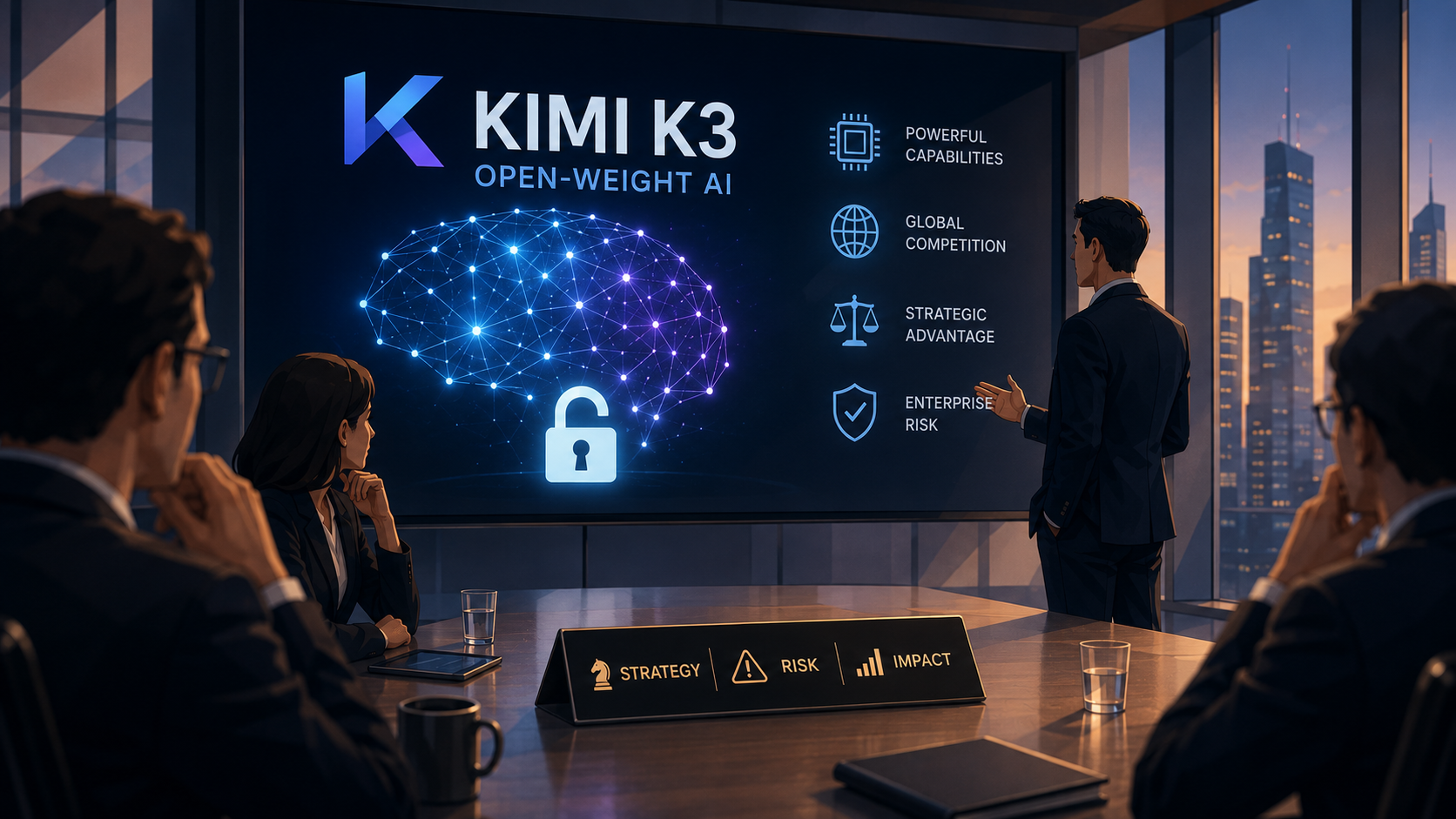
Kimi K3 is the open-weight AI release that changed the conversation this weekend. Moonshot AI has put a very large model into a market still largely organised around closed frontier APIs, and the early attention is not only about benchmark claims. It is about the strategic consequence: another serious model option can be inspected, deployed and adapted outside a single US lab’s product boundary.
Associated Press reported on the launch, while CNBC focused on the renewed pressure it puts on assumptions about the open-weight market. The lesson for builders is less dramatic and more useful: model choice is becoming an architectural decision again, not just a subscription decision.
Why Kimi K3 makes open-weight AI a board-level question
Moonshot describes Kimi K3 as an open-weight release. Reports put the model at 2.8 trillion total parameters, a reminder that “open weight” does not mean “runs on a laptop.” The important distinction is ownership and optionality, not effortless self-hosting. A model can be large, expensive to serve and still give capable teams more control over where it runs, how it is evaluated and whether it can be tailored to a constrained workflow.
That is why the release matters beyond the usual leaderboard debate. A closed API gives a team speed: someone else operates the inference stack, issues updates and absorbs much of the infrastructure work. An open-weight model creates a different asset: the ability to choose a trusted host, examine the deployment path, preserve a version, and potentially adapt a model without waiting for an API vendor’s roadmap.
Neither path is automatically superior. The word “open” should not become a proxy for secure, cheap or production-ready. Licensing, data handling, capacity, model safety, evaluation and incident response still need to be checked. Nor should a performance claim from any vendor decide a purchase on its own. The practical shift is that a serious alternative is now part of the conversation at a scale that investors and enterprise buyers cannot dismiss as hobbyist infrastructure.
Open-source watch: the surrounding stack is moving too
Kimi K3 is the headline, but two adjacent updates show why a model release is only one part of the story.
- Hugging Face and NVIDIA: their new guide on fine-tuning video and image models with NeMo AutoModel and Diffusers is infrastructure news, not a new foundation model. It matters because adaptation and training workflows are becoming easier to test in a standardised toolchain.
- Ollama: version 0.32.1 is now available. A point release is not a frontier event, but dependable local tooling is exactly what turns the idea of a private or offline fallback into something a small team can actually trial.
These are different layers of the same market. Huge open weights expand the strategic menu. Training and serving tools determine whether that menu is usable. Teams should resist treating the model itself as the whole product: the durable advantage is the evaluated workflow around it.
What builders should take from Kimi K3
For an agent that answers website enquiries, helps a sales team prepare, or routes a customer request, start with the job rather than the model’s reputation. Which data is sensitive? Which answers need a source? How much latency is acceptable? Who approves an action? What happens if the preferred provider is unavailable or changes price?
Those questions often lead to a mixed design. A hosted frontier model can handle the high-judgement or multimodal steps where it demonstrably earns its cost. A smaller or open-weight model can handle bounded classification, retrieval, drafting or private internal work. The orchestration layer should make those choices visible: route by task and policy, log the result, and provide a human handoff. It should not quietly send every business question to whichever model is fashionable that week.
This is the same operating principle behind choosing where each AI workload should run and building an AI switchboard instead of one superbrain. Kimi K3 expands the routing options, but the business still needs a clear policy for cost, privacy, quality and escalation.
For small businesses, Kimi K3 is not a reason to build a data centre. It is a reason to reduce accidental lock-in. Keep the source material that powers an assistant tidy and portable. Version prompts and policies. Maintain a small evaluation set drawn from real customer questions. Test an alternative route before an outage or pricing change forces the issue. Those habits make a cloud-first setup more resilient today, even if a local or open-weight option never becomes the default.
5 practical Kimi K3 lessons for AI builders
- Start with the workload. Decide what must be private, sourced, fast or human-approved before comparing models.
- Treat open weights as optionality, not free infrastructure. Kimi K3 is large; hosting, evaluation and incident response still carry real costs.
- Route by policy. Use frontier APIs for tasks that earn their cost and bounded models for private, repeatable work.
- Keep your workflow portable. Version prompts, policies, source material and evaluations so changing providers is possible.
- Measure before migrating. Test Kimi K3 and competing models against real business questions rather than relying on vendor benchmarks.
Kimi K3 is a meaningful open-weight signal, not proof that every company should replace a managed model tomorrow. Its arrival makes the right question harder and better: where should this particular AI workload run, and what control must the business retain? The winners will not be the teams that declare allegiance to closed or open models. They will be the teams that can compare both honestly, move when economics or privacy requirements change, and keep their agents accountable to a real operating design.


Leave a Reply