
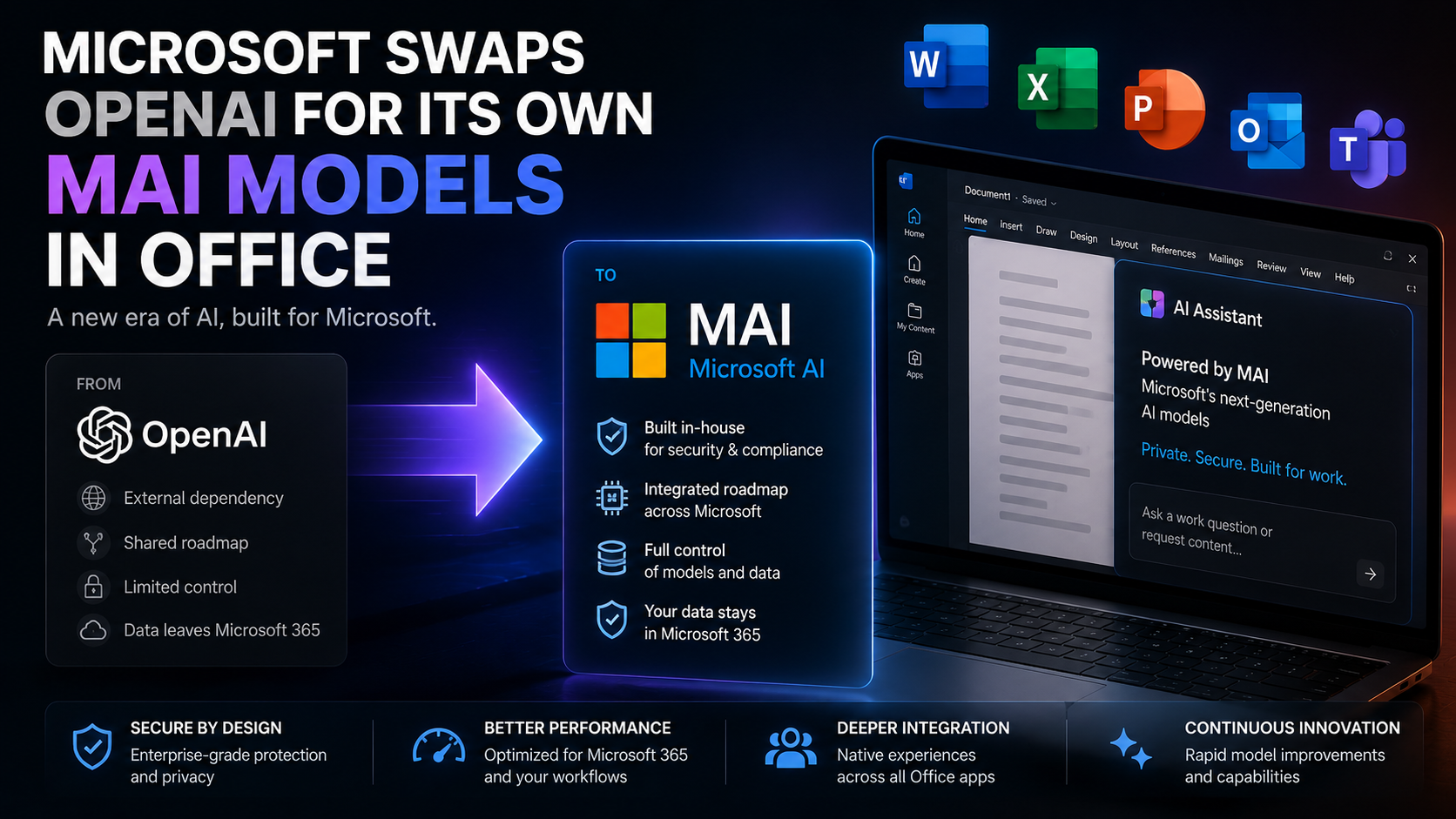
Microsoft is quietly swapping OpenAI and Anthropic models out of Word and Excel, replacing them with its own in-house MAI models for a share of user prompts. It is the clearest sign yet that the biggest AI buyers are balking at the per-token bill — and the most consequential model-sourcing shift since Microsoft first bet on OpenAI.
The same week, Anthropic pushed Claude Cowork beyond the desktop and onto phones and the web, DeepSeek confirmed it is designing its own inference chips to escape the Nvidia-Huawei duopoly, and Meta launched an AI image generator that immediately drew a privacy backlash. The throughline is simple: the companies that built their AI stacks on rented frontier models are now trying to own more of the stack — compute, model, and surface.
The big signal: Microsoft starts replacing OpenAI inside Office
Bloomberg reported, and TechCrunch confirmed on July 7, that Microsoft has begun routing a percentage of Word and Excel prompts to its homemade MAI models instead of the OpenAI and Anthropic models that previously powered those experiences. Microsoft still relies on third-party frontier models, but the direction of travel is unmistakable: in-house first, rented second.
This matters because Microsoft is not a cash-strapped startup. If the company that essentially bankrolled the OpenAI scaling thesis decides its own models are good enough for the world’s most widely used productivity apps, the economics of frontier-model licensing just shifted. Microsoft announced seven new MAI models at Build last month — including an agentic coder and a text-to-image generator — and the Office swap is the first visible evidence those models are being put to work at scale.
It is part of a broader cost-cutting wave. Amazon, Uber, Meta, and Accenture have all reportedly made moves to curb AI spending in recent months, and some companies are reportedly looking to cheaper Chinese models for agentic workloads despite security concerns. The “tokenmaxxing” era — where teams defaulted to the most expensive frontier model for every task — is fading. Model routing is becoming a balance-sheet decision, not a vibe.
Claude Cowork goes mobile: the agent surface war
Anthropic expanded Claude Cowork to web and mobile on July 7, moving the coding-agent-turned-general-work-assistant beyond its desktop origin. Max subscribers can now start a task at their desk, get status updates on their phone, and pick up finished output later — even with the laptop closed. Anthropic also unified chat and Cowork across web and desktop, with projects and artifacts living together.
Anthropic’s own usage data from 1.2 million anonymized Cowork sessions across 600,000 organizations tells a clear story: the biggest category (33.4%) is “business process operating” — pulling scattered updates into a report, building onboarding checklists, reconciling spreadsheets. That is the work around the work that keeps companies running but is rarely anyone’s core job. Anthropic also recently launched Claude Tag, an always-on Claude that lives in Slack.
OpenAI is making a parallel push with Codex, which began as a developer tool and is increasingly used by non-developers for reports, spreadsheets, and analysis. The bet from both labs is the same: the winner is not whoever has the best chatbot, but whoever owns the surface where work actually happens. For anyone building agentic tools, the message is that mobile and background execution are now table stakes, not a roadmap item.
DeepSeek designs its own chips to escape the Nvidia-Huawei trap
Reuters reported, via Ars Technica on July 7, that DeepSeek has been working on custom silicon for about a year, meeting with hardware partners and hiring chip engineers. The focus is data-center inference chips — not training — with the goal of reducing reliance on both Nvidia (blocked by US export controls) and Huawei (which controls roughly half of China’s data-center chip market).
DeepSeek is not alone. Alibaba and Baidu are making similar chip moves inside China, while OpenAI and Broadcom jointly announced the Jalapeño inference chip weeks ago, and Anthropic has been exploring custom silicon. The pattern is global: every frontier lab that can afford it wants to own more of the stack, because compute access remains the binding constraint on AI scale. For builders, this means inference economics will keep shifting under your deployment — the model you pick today may run on very different hardware tomorrow.
Meta’s Muse Image and the privacy backlash
Meta launched Muse Image on July 7, built by Meta Superintelligence Labs. The generator includes presets, prompt-based editing, Facebook Marketplace integration for interior design mockups, and new AI effects for Instagram Stories. The controversial feature: users can manipulate another Instagram user’s photos with AI by tagging them, as long as their profile is public — and the tagged person is not notified.
Meta says users have settings to disable this, but the default posture — “people may be able to create content with your Instagram content using AI features at Meta” — is exactly the kind of opt-out privacy model that erodes trust. It is a useful negative example for anyone building agentic or multimodal tools: default consent settings are a product decision, not a legal footnote.
Open-source watch: frontier owns discovery, open source owns production
TechCrunch’s Russell Brandom highlighted a framework from Decagon CEO Jesse Zhang on July 7: open-source models are not competing with frontier labs so much as capturing the production phase of a life cycle that frontier models prove out. Vercel’s AI gateway dashboard shows DeepSeek now processing over a third of token volume, with Z.ai’s GLM-5.2 in fourth — yet Anthropic still accounts for more than half of overall AI spend on the platform. On OpenRouter, DeepSeek V4 Flash leads usage at 5.3 trillion weekly tokens, while the most popular frontier model (Opus 4.8) handles 2 trillion at roughly 23x the per-token cost.
Read one way, this is good news for frontier labs: the market of AI-addressable tasks is growing fast enough that new use cases keep arriving to fill the gap. Read another way, it confirms a two-tier economy where the premium token price is the only thing keeping frontier margins intact. Nvidia’s Nemotron was flagged as the next model poised to leap into the open-weight pack, which would put further pressure on the production tier.
On the tooling side, Rowboat — an open-source, local-first alternative to Claude Desktop — surfaced on Hacker News this week, aimed at teams that want an agentic desktop without sending everything to a frontier lab. It is early, but it reflects a real appetite for local-first agent runtimes that complement, rather than replace, cloud models.
Fable 5 access extended through July 12
Anthropic announced on July 7 that Claude Fable 5 access is being extended to all paid plans through July 12. The model returned to limited release on July 1 after being pulled from general access during the US safety-testing standoff. The extension suggests demand is outpacing the staggered rollout — and that Anthropic is using paid-tier gating as the practical throttle, rather than the government-mandated one.
What builders should take from this
Three things are now clear from this week’s moves:
- Model routing is a financial decision. Microsoft’s Office swap proves that even the deepest pockets are optimizing per-task model assignment. If you are defaulting every call to one frontier model, you are overpaying.
- The agent surface is expanding past the desktop. Claude Cowork on mobile, Codex for non-developers, and Claude Tag in Slack all point to the same trend: agents are becoming ambient, cross-device, and background-running. The product question is no longer “what can the agent do?” but “where does the agent live?”
- Compute independence is the new moat. DeepSeek, OpenAI, Anthropic, and the Chinese giants are all converging on custom silicon. For smaller teams, the practical version of this is choosing model-serving infrastructure that lets you swap providers without a rewrite.
The practical takeaway
The AI stack is splitting into layers, and the companies winning right now are the ones who own more than one. Microsoft owns the model and the surface. Anthropic owns the model, the agent, and is pushing into the surface. DeepSeek is reaching for the compute. Meta owns the model and the distribution — but is testing how much privacy friction users will tolerate along the way.
For small teams and builders, the lesson is to design for flexibility: route between models based on cost and task, run agents where your users actually work, and treat your model provider as replaceable rather than permanent. The week’s news is not about any single model getting smarter. It is about the companies around the models getting shrewder about where the value actually accrues.

Leave a Reply