
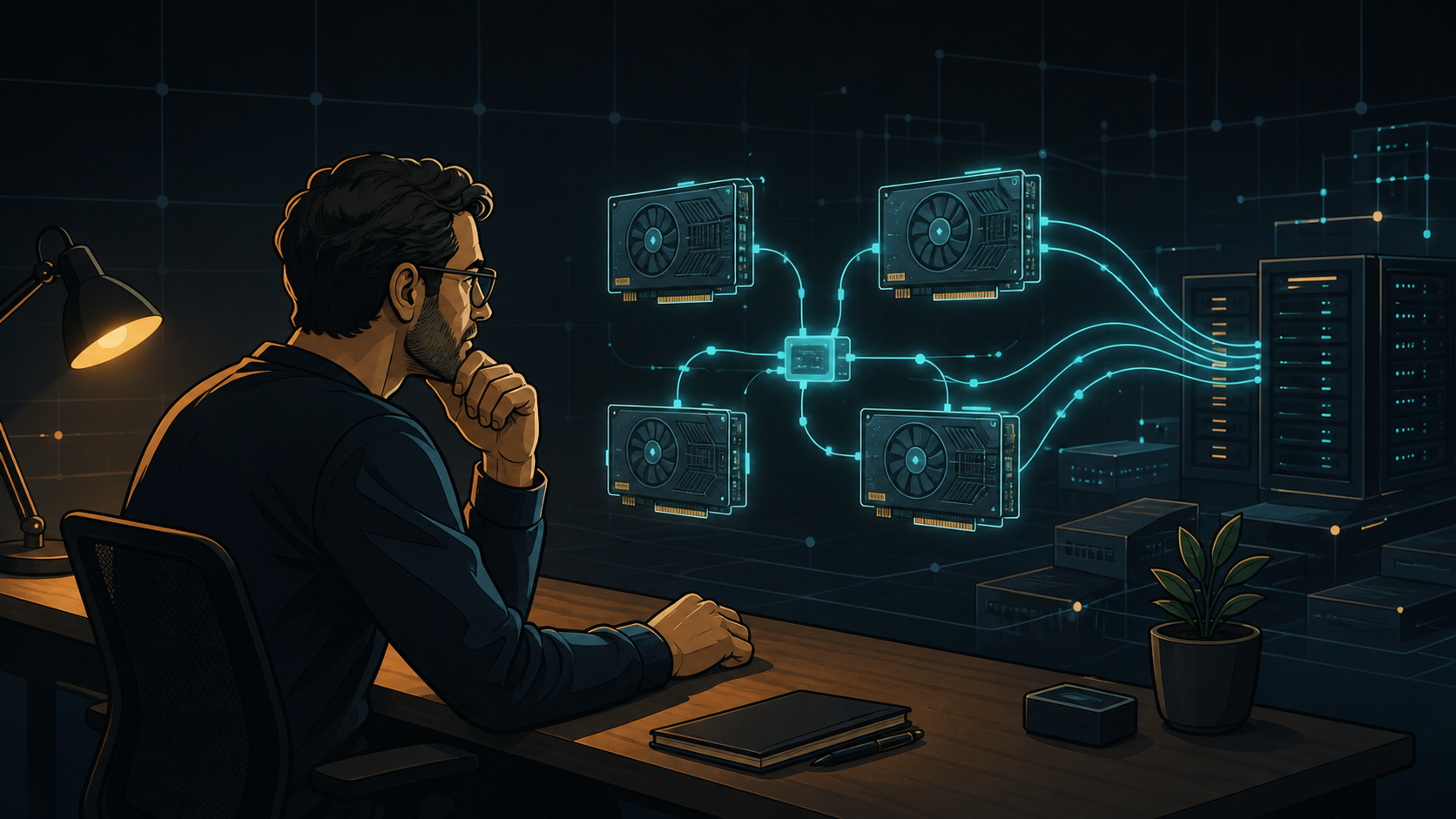
NVIDIA AI compute financing is the signal worth watching this morning. NVIDIA says it has partnered with Apollo, BlackRock, Blackstone, Brookfield, Goldman Sachs and KKR to establish AI-compute infrastructure financing platforms intended to mobilize more than $500 billion of third-party capital. That is not a model launch. It is a move to make the machines behind models easier to finance—and it matters because the next constraint on useful AI may be less about clever demos than dependable capacity, economics and access.
The big signal
The NVIDIA announcement is easy to read as another very large number in the AI race. The more useful reading is that AI infrastructure is being treated less like a one-off corporate technology purchase and more like an asset class with specialist financing around it. NVIDIA’s language is about platforms that can connect capital to compute infrastructure; it is an intention to mobilize third-party funding, not a guarantee that every dollar will be deployed tomorrow. In that sense, NVIDIA AI compute financing is about a new route from capital to usable capacity, not a shortcut past operational discipline.
That distinction matters for operators. A company building an assistant does not buy “AI” in the abstract. It buys latency, inference capacity, storage, evaluation time, observability and people who can run the service. If more capacity becomes financeable and therefore more available, model providers and cloud platforms may be able to offer more options. But it does not automatically make an agent useful, safe or affordable at the task level.
For investors, this makes a clean separation more valuable: infrastructure demand can grow while application value remains uneven. The winning application is not simply the one connected to the most GPUs. It is the one that turns a bounded amount of compute into a verified customer outcome. That is why a real AI evaluation set and a clear operational definition of success are becoming more important, not less.
For small teams, the headline is a reminder to avoid planning around permanent scarcity or permanent abundance. Design for substitution: a hosted frontier model when quality is essential, a smaller model where speed and privacy matter, and a way to measure both. The cost question is part of product design. Our recent guide to an AI latency budget is relevant here: a user experiences the wait, not the size of the infrastructure commitment behind it.
Open-source watch
The infrastructure story landed alongside practical open tooling updates rather than a single must-drop-everything open-weight model release. Two are worth putting on the builder radar because they change what it takes to operate choice.
- vLLM 0.27.0 adds support across several model families, including Kimi K3, Qwen3.5 and VaultGemma, while its release notes also call out serving and kernel work. The practical point is not to chase every supported model. It is to make a serving layer capable of testing a model change without redesigning the whole application.
- Ollama 0.32.7 documents initial support for Meta’s Muse Glimmer through its MLX engine on Apple Silicon; the next release candidate expands Muse Glimmer support across NVIDIA, AMD and additional platforms. That is a useful local-AI signal: hardware portability still arrives in increments, so teams should validate the exact hardware, quantization and workload they expect to run.
- llama.cpp b10356 updates its ROCm build and release targeting. It is not a flashy product story, but it is the kind of maintenance that determines whether an open model is actually viable on a team’s chosen hardware.
Taken together, these releases offer a counterweight to the financing news. Huge centralized build-outs can widen the menu of cloud capacity; open serving projects preserve an exit route. A sensible stack needs both options, especially when customer data, regional deployment or unit economics rule out a one-model, one-cloud answer.
Why NVIDIA AI compute financing matters
At meLink, we care about the layer where a visitor asks a real question and an agent must decide what to do next. More AI infrastructure does not remove the need for careful orchestration. In fact, it raises the standard: if inference becomes easier to buy, then workflow quality, privacy boundaries and human handoffs become a clearer differentiator.
Start with workload mapping. A website sales assistant may need low-latency retrieval and a tightly limited tool set. A back-office research workflow may tolerate a slower, more capable model with explicit approval gates. A private personal coordinator may justify a local or regional deployment even if its benchmark score is lower. Put those choices behind interfaces, record the model and policy used for important actions, and make failure visible. The case for this is the same as the case for local AI releases that matter to real products: deployment is a product decision, not just an engineering preference.
Then pressure-test a simple question: what happens if a preferred provider gets expensive, capacity-constrained or unsuitable for a customer’s data? An answer such as “we will switch models” is not a plan. A plan includes compatible prompts and tools, evaluation cases, a fallback route, telemetry, and someone empowered to pause the workflow. That is how a small team converts market optionality into operational optionality.
The practical takeaway
NVIDIA AI compute financing is a macro headline with a very concrete product lesson. Compute may become more investable and more available, but the valuable work remains local to the product: choose the smallest capable setup for each job, retain a credible alternative, and prove the agent can deliver an outcome people can check.
This week, pick one customer-facing workflow and write down its model, data boundary, latency target, estimated cost per completed task and fallback behavior. Run it against a small evaluation set before changing providers or chasing a new release. That discipline gives a business more leverage than simply having access to the largest possible AI infrastructure.


Leave a Reply