
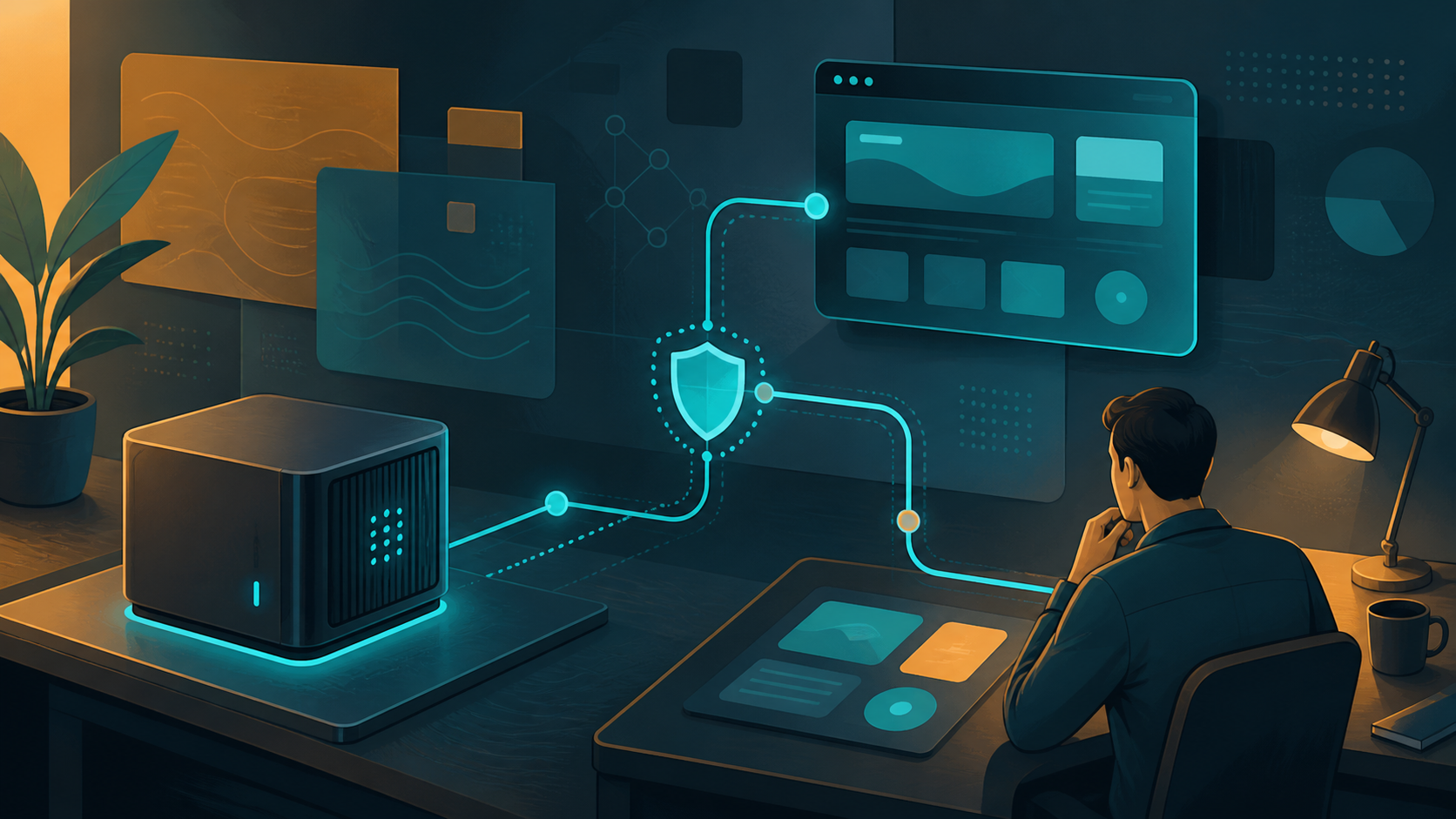
Ollama’s latest release is a useful reminder that local AI agents are becoming a deployment decision, not just a research project. Version 0.32.9 adds NVIDIA Nemotron 3.5 Lightning to the Ollama library and ships architecture support for Nemotron 3.5. For small teams building always-on assistants, that combination matters more than another abstract benchmark: it puts a model intended for an agent execution layer beside a widely used local runtime.
Local AI Agents: The Big Signal
The headline is not that every business should run a 30B mixture-of-experts model on a laptop. It is that the local path for an agent is getting less hypothetical. Ollama 0.32.9 announces NVIDIA Nemotron 3.5 Lightning as an open 30B MoE model with 3B active parameters and identifies it as a model for the execution layer of always-on agents. The release also adds the Nemotron 3 architecture to Ollama.
That active-parameter figure is the practical detail worth pausing on. MoE designs can concentrate compute on a smaller portion of a larger model for each token. That does not erase memory, evaluation, or operations constraints. It does mean the useful question for a product team is no longer simply “cloud model or local model?” It is: which parts of an agent loop need the strongest remote reasoning, and which can run with tighter control over data, cost, and latency?
NVIDIA’s NemoClaw repository, referenced in the release, frames the surrounding work as open-source security and management for always-on agents. That is an important pairing. A model download is not an agent platform. Long-running tools need policy boundaries, logs, retries, human escalation, and a way to stop them. The more accessible models become, the more those boring-but-essential layers become the product.
Open-source watch
Two adjacent releases make the same point from different directions.
- Ollama 0.32.9: beyond the Nemotron addition, the release includes a Muse Glimmer function-calling parser boundary-condition fix. Tool calling is where a chat demo turns into an operating workflow; parser fixes are small on paper but can matter in production.
- vLLM 0.27.1: the patch release adds support for quantized DSpark Markov heads. It is a narrow serving change, but it reflects the continuing work needed to make specialized and quantized model components usable in real inference stacks.
- Muse Glimmer: Hugging Face’s recent overview describes Meta’s open-source, local, agentic, multimodal release. Its relevance here is not a claim that one model wins; it is that builders now have more choices for a local agent’s perception and tool-use layers.
These are not interchangeable projects. Ollama is a local model runtime; vLLM is widely used serving infrastructure; Muse Glimmer is a model family. Treating them as a single “open source AI stack” would hide the design work. But together they show why local AI agents deserve a serious architecture conversation: model capability, runtime support, inference operations, and tool reliability are moving at the same time.
What builders should take from this
For meLink, the useful pattern is hybrid by design. A website sales assistant does not need to send every low-risk retrieval, routing, or structured task to a frontier API. A local or private-capable component can handle bounded work close to the customer’s data, while a cloud model can be reserved for tasks that genuinely need broader reasoning or multimodal capability. The point is not to promise that local AI agents are automatically cheaper or safer. The point is to make that choice explicit and measurable.
That framing connects with our recent look at giving agents a source of truth: a capable model without controlled context can still guess. It also complements our case for AI agent observability. Whether a step runs locally or in the cloud, a team needs to know what the agent saw, which tool it called, what it changed, and when a person should take over.
Small businesses should resist the temptation to turn this news into an infrastructure project. Start with one bounded workflow: qualify an inbound request, retrieve from an approved knowledge base, draft a handoff, or monitor a site for a defined condition. Set a latency budget, define data that must not leave a chosen boundary, and log tool calls. Then compare a local option with a hosted option against the same test set. That is more valuable than choosing a stack because it sounds private or powerful.
The practical takeaway
local AI agents are getting more plausible because the pieces around the model are improving: runtimes recognize new architectures, serving projects support more model components, and security tooling is becoming part of the conversation. The release to watch is therefore not just Nemotron 3.5 Lightning. It is the emerging expectation that an agent stack should let a small team choose where work runs and still keep that work observable and controllable.
For investors and builders, that is the signal: value will not accrue only to the largest model. It will also accrue to products that make model choice, tool permissions, context quality, and human handoffs feel dependable. That is the standard practical agentic AI has to meet.
Leave a Reply