

Every customer-facing AI assistant has the same moment: the demo works, everyone nods, and someone says “let’s put it live on Monday.” That gap — between a demo that handled the happy path and an assistant that is about to meet a real person at 9:47pm on a Tuesday — is where most customer-facing AI projects quietly fail. Not in the model. Not in the prompt. In the rehearsal that never happened.
A dress rehearsal is the last honest step before an AI touches a real customer. You run it through a small, deliberate set of visitor-shaped conversations and edge cases, and a human reviews what actually happened before signing off. It is not a test suite in the engineering sense. It is the operational equivalent of opening the doors on a quiet morning and walking the floor before the first real guest arrives.
The demo-to-live gap is real
Demos are kind. The person running the demo asks a reasonable question, in a reasonable tone, with reasonable context. The assistant answers well. Everyone feels good. Then you ship it, and a real visitor shows up tired, impatient, typing on a phone, asking something that sits halfway between two of your product categories. The assistant does something the demo never exposed — routes the question to the wrong place, invents a feature, or gives a confident answer to something it was never told.
This is not a model problem. It is a readiness problem. You learned almost nothing about the assistant’s real behaviour from the demo, because the demo only proved it could handle the one conversation you already knew the answer to. The rehearsal exists to find out what happens in the conversations you do not already know the answers to.
What a dress rehearsal actually is
A dress rehearsal is a small set of realistic conversations, run through the assistant in its real configuration, with a human reading what it did and deciding whether it is ready. Five scenarios is enough to start. The point is not coverage of every possible visitor. The point is to expose the assistant to the shapes of conversation that reveal whether it is safe to leave unsupervised with a real person.
A practical five-scenario set
- The qualified buyer. A visitor with a real need, a budget question, and three tabs open on your pricing page. Does the assistant qualify, answer from approved sources, and hand off cleanly — or does it improvise a price?
- The frustrated repeat visitor. Someone who has already tried the docs, the contact form, and a previous chat, and is now short-tempered. Does the assistant stay useful, acknowledge the friction, and route to a human — or does it loop back to the same generic help text?
- The off-topic question. A visitor asking something the assistant has no business answering — a competitor comparison, a legal opinion, a personal question. Does it stay in its lane politely, or does it confidently stray?
- The privacy-conscious visitor. Someone who asks what the assistant does with their information before they share it. Does it give an honest, scoped answer — or does it dodge?
- The silent or ambiguous one. A visitor who types one word, or asks something that could mean three different things. Does the assistant ask a clarifying question, or does it pick the most likely interpretation and run with it?
These five are not exhaustive. They are the conversations that most reliably surface the difference between an assistant that is ready and one that merely performed well in a demo.
Review the rehearsal, not just the answers
The rehearsal is not a pass/fail test of whether the answers were good. It is a review of how the assistant behaved. Before you sign off, ask three questions about each scenario:
- Did it stay in its lane — answering from the sources and scope you gave it, and refusing what it should not touch?
- Did it know when to stop — handing off to a human, asking a clarifying question, or saying it did not know, rather than pushing through?
- Did the plan it followed match the plan you would have wanted — the steps, the sources consulted, the routing decisions, the approval gates?
If the answer to any of those is no, you have not failed. You have found something before a customer did. That is the entire purpose of the rehearsal. Fix it, run the scenario again, and keep going until the behaviour is what you would defend to a customer who read the transcript afterwards.
Why visual orchestration makes the rehearsal honest
Reading an assistant’s final answer is not enough to judge readiness. A good answer can come from a bad path — the right source consulted for the wrong reason, a tool called that should not have been, a branch taken that skipped the human checkpoint. To review a rehearsal properly, you need to see the plan the assistant followed, not just the words it produced.
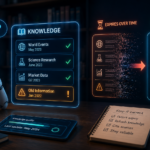
This is where visual orchestration earns its keep. When the assistant’s path is rendered as an inspectable canvas — the steps, the sources, the routing decisions, the approval gates, the places it paused — the reviewer can see whether the assistant reached its answer the right way. Two assistants can produce the same sentence. One arrived there by consulting an approved source and routing on uncertainty. The other guessed and got lucky. You cannot tell them apart from the answer alone. You can tell them apart from the plan.
For a website coverage assistant, this is especially important. The visible plan shows which knowledge source the assistant used, whether it stayed inside the public-answer set, whether it flagged the conversation for human follow-up, and where it would have escalated if the visitor had pushed further. That is the difference between reviewing a transcript and reviewing a system.
The sign-off rule
The rehearsal ends with a single decision: is this assistant ready to meet a real customer? That decision belongs to a human — the same person who will own the lane once it is live. Not the person who built it. Not the person who demoed it. The person who will be accountable when a real visitor has a real conversation at an inconvenient hour.
That distinction matters. The builder and the demo-runner are invested in the assistant succeeding. The owner is invested in it not causing harm. The rehearsal is the moment where the owner gets to say “not yet” without it being a criticism of the build. “Not yet” is the most useful outcome a rehearsal can produce, because it is the one that prevents the costliest kind of failure — the one a real customer discovers for you.
Make it a habit, not a ceremony
A rehearsal is not a one-time gate before launch. Every meaningful change — a new source, a new permission, a changed prompt, a different model — deserves a small re-run of the scenarios most likely to be affected. You do not need to redo all five every time. You need to rerun the ones where the change could change the behaviour. A release-notes habit tells you what changed. The rehearsal tells you whether the change is safe to ship.
This is the discipline that separates a team that ships AI from a team that ships AI responsibly. The demo proves the assistant can do the thing. The rehearsal proves it can be trusted with a real person. Most teams skip it because the demo felt like enough. It never is.
Start with one assistant and five conversations
If you have not run a rehearsal yet, do not build a framework. Pick the one customer-facing assistant closest to going live. Write five conversations in the shapes above. Run them through the assistant in its real configuration. Read what it did, and look at the plan it followed. Then decide whether it is ready.
You will almost certainly find something. That is the point. The cost of finding it in a rehearsal is an hour. The cost of finding it in a real customer conversation is a lost sale, a broken trust, or a privacy moment you cannot take back. The rehearsal is the cheapest insurance you will ever buy for an AI that is about to represent you.
You have got this. And now your assistant has been checked before it has to.

Leave a Reply