

Everyone writes about how to use AI. Almost nobody writes about when not to use AI. That gap is telling. The default assumption in most business AI advice is that every repetitive task, every customer touchpoint, every analysis pipeline should eventually be automated. But the teams getting the most value from AI are not the ones automating everything — they are the ones who know which lanes to leave alone.
Table of Contents
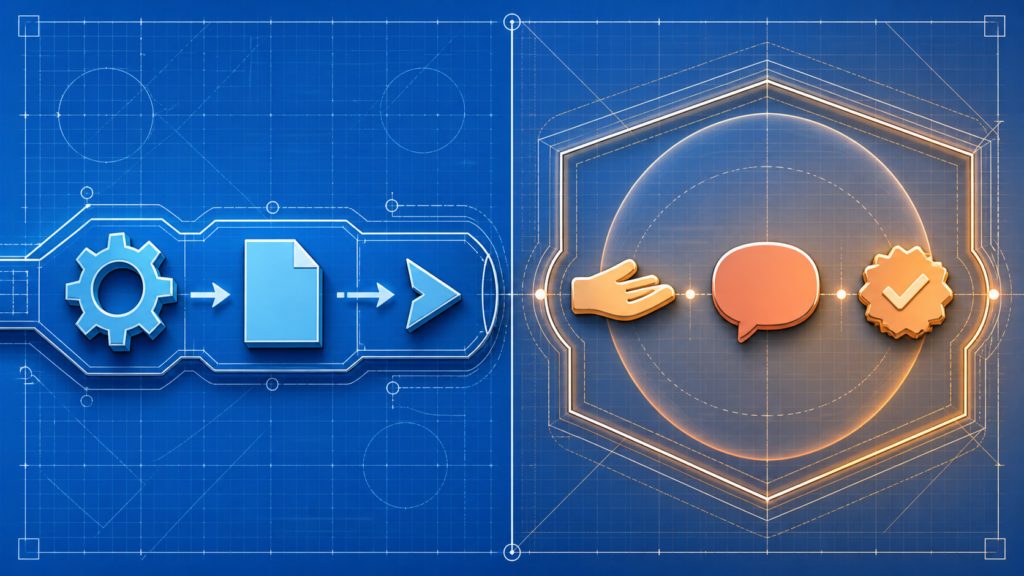
The Lane That Builds Trust
There is a kind of conversation that does not transfer information. It transfers confidence. The first real sales call, the moment a prospective client asks whether your team can handle their edge case, the conversation where someone decides whether they trust you with their data — these are not transactions. They are trust-building events, and the human presence in them is not a cost to be optimized away. It is the mechanism itself.
This is not an argument against AI choice architecture or always-on website coverage. AI can qualify, answer, and route brilliantly. But the moment where a buyer decides your company is worth a long-term commitment is usually a human moment. Automating that moment saves time and loses the deal.
The test is simple: would a prospect feel more or less confident in your company if they learned this interaction was automated? If less, keep it human. The goal of AI in sales is to make sure the human gets to the right conversation at the right time — not to replace the conversation that closes the relationship.
The Lane With Real Consequences
Some decisions are reversible. AI is excellent for those: draft the email, generate the summary, classify the ticket, suggest the response. If the output is wrong, a human catches it before any harm reaches a customer. But some decisions are not reversible — or the cost of being wrong is so high that the probability of error matters less than the accountability structure around it.
Legal commitments, medical guidance, financial advice tailored to a specific person, any statement that creates a binding obligation or a reasonable expectation of one: these belong to humans. Not because humans are smarter — they are not, in many domains — but because accountability requires a person who can explain why the decision was made, take responsibility when it is wrong, and change course in real time when new information arrives.
The NIST AI Risk Management Framework makes this distinction explicit: AI systems should be deployed with an understanding of their risk context, and high-consequence decisions require governance, traceability, and human accountability. An AI decision record can capture what happened — but it cannot make a wrong medical recommendation right, and it cannot sign a contract. Knowing when not to use AI means knowing where the consequences of being wrong are not worth the efficiency of being fast.
This is also where AI promise maps become essential: they define what an assistant is allowed to claim. If the promise has legal weight, the map should point to a human, not a model.
The Lane Where Presence Is the Product
Some services are valuable precisely because a human showed up. The therapist who listens, the consultant who sits in your office and understands your specific mess, the support engineer who gets on a call at 2am during an outage — the value is not the information they provide. It is the fact that a person cared enough to be present. If you automate that lane, you do not save money. You eliminate the thing people were paying for.
This is the hardest distinction for teams building AI products: the difference between the information a task produces and the relationship a task creates. AI can produce the information. It cannot create the relationship. A Harvard Business Review piece on automation decisions makes a related point: the tasks that build trust, negotiate commitment, or require contextual empathy are often worth keeping human, even when automation is technically feasible.
The practical question is not “can AI do this?” but “if AI did this, would the customer still value it?” If the answer is no, the lane is not a candidate for automation. It is a candidate for human investment.
The Replaceability Test: When Not to Use AI
If you are not sure whether a lane should stay human, run this test. Imagine the AI does the job perfectly — fast, accurate, available 24/7. Now ask three questions:
- Would the customer feel differently if they knew no human was involved? If yes, the lane has a trust component that automation would erode.
- Is there a decision in the lane that could create a binding commitment, a health impact, or a financial obligation? If yes, accountability requires a human signer.
- Is the human presence itself part of what the customer values? If yes, automating the lane removes the product, not the cost.
If any of these answers is yes, the lane should stay human or stay hybrid with a human checkpoint. AI can support the lane — prepare the briefing, draft the response, surface the relevant context — but it should not own the lane. There is a difference between AI capacity planning (sizing the human queue behind an assistant) and deciding the queue itself should not exist.
The Hidden Cost of Automating the Wrong Lane
Learning when not to use AI means understanding that automating the wrong lane does not just fail silently. It actively damages the business. The trust-building sales conversation that becomes a chatbot erodes the relationship before it starts. The consequence-heavy decision that becomes an AI suggestion dilutes accountability — nobody owns the outcome because the model made the call. The presence-based service that becomes a self-service portal removes the thing the customer was paying for.
Research from MIT Sloan on AI and human judgment reinforces this: in decisions involving contextual nuance, stakeholder relationships, or ethical weight, human judgment remains not just preferable but structurally necessary. The cost of removing it is not just lower quality. It is the loss of the very capability that made the business worth working with.
And there is a second cost: pilot graveyards are full of AI experiments that automated the wrong lane, saw no improvement, and concluded AI does not work. The technology was fine. The judgment about where to apply it was wrong. Knowing when not to use AI is not anti-AI. It is the precondition for using AI well.
Restraint as Strategy
The companies that get the most from AI are not the ones that automate the most. They are the ones that automate the right lanes and protect the rest. They use AI for coverage — answering, routing, drafting, summarizing — and they keep humans for trust, consequence, and presence. That split is not a limitation. It is a strategy.
When you know when not to use AI, your AI investments compound instead of scatter. Your team trusts the automation because it does not threaten the work they value. Your customers trust your company because the moments that matter are still human. And your AI runs in the lanes where it belongs: fast, bounded, reversible, and genuinely useful.
Restraint is not the opposite of ambition. It is how ambition avoids becoming waste. The best AI strategy starts with a clear answer to one question: what stays human, and why? Get that right, and everything else gets easier.

Leave a Reply