
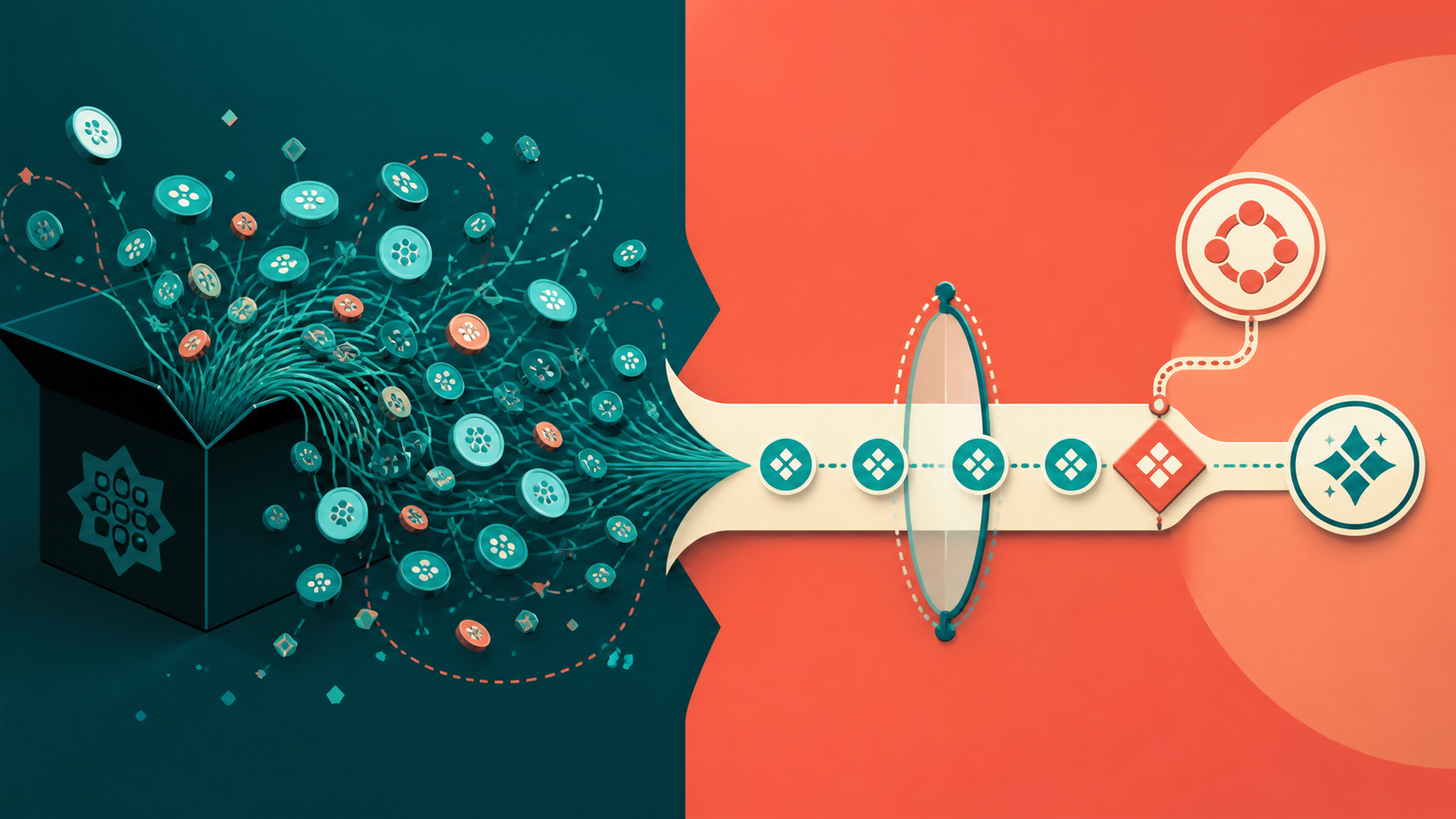
An AI pricing model is a promise about work: what a customer can expect, where ordinary use ends, and what happens when a request becomes unusually expensive or consequential. Too many products make that promise backwards. They advertise “unlimited AI,” absorb every variable cost in silence, then discover that their most engaged customers are also the hardest to serve profitably.
Table of Contents
Unlimited is not a product strategy
“Unlimited” sounds generous because it removes a buying decision. But it does not remove the underlying economics. An AI feature has variable ingredients: model inference, retrieval, tool calls, storage, support, review, and sometimes a human who steps in when the work should not continue automatically. Those costs do not rise in a neat line, and the most valuable customer requests are often the least predictable.
That does not mean every AI product needs a token meter in the customer’s face. It means the company needs an honest theory of ordinary use. A website assistant that answers documented product questions is one kind of service. An assistant asked to compare a bespoke contract, research a private account history, and draft a tailored proposal is another. Calling both “a chat” hides the product decision.
Public model prices also change over time; the OpenAI API pricing page is a useful reminder that infrastructure costs are a moving input, not a stable customer promise. The durable part of a product is the outcome and the operating boundary around it.
Start with the outcome, not the model
A better AI pricing model begins with a customer outcome that can be recognized without looking at a model log. “Qualified website conversation delivered to the right person.” “A reviewed first draft of a weekly update.” “A triaged support request with approved evidence attached.” These are things a buyer can value and an operator can design around.
Then ask four practical questions:
- What is the useful unit of work the customer is buying?
- What evidence or source set is included in that unit?
- What behaviour is ordinary enough to include by default?
- What request changes the risk, cost, or human responsibility enough to need a different path?
This is not a return to old-fashioned per-seat software. It is a refusal to sell a vague capability when the buyer actually needs a reliable service. Stripe’s overview of usage-based pricing usefully frames the trade-off: a meter can align price and value, but it must be intelligible. For AI, the most intelligible meter is often a completed, bounded outcome—not raw tokens, which mean little to most operators.
Make ordinary use visible
Every product has a normal lane. The mistake is leaving it implicit until a customer crosses it. Define the lane in product language: which channels are covered, which approved knowledge the assistant uses, what kind of question it can resolve directly, and the response window it is designed to meet.
For a business using an AI website assistant, ordinary use might mean answering public product questions, collecting basic qualification details, and creating a clean morning handoff. It would not mean inventing custom implementation commitments or negotiating unusual terms. The point is not to make the experience stingy. It is to make the assistant dependable precisely where it is meant to operate.
The operational side matters. An AI service cannot promise instant escalation if the team behind it has no capacity to respond. AI capacity planning starts with the human queue: demand peaks, safe completion, and response windows must be designed together. An honest commercial boundary gives that human queue a chance to work.
Treat exceptions as a choice
The best moment in an AI pricing model is not the automatic answer. It is the moment the product recognizes an exceptional request and offers a clear next choice. That might be a paid research lane, a scheduled expert review, a higher service tier, or a human-led project. The customer should understand why the path changed and what they receive next.
This is better than silently burning margin, throttling an account without explanation, or letting an agent overreach to preserve the illusion of instant service. It also protects trust. A customer usually accepts that a bespoke request takes more care; they do not accept a confident automated answer that turns out to be a guess.
In practice, write down three exception triggers before launch: a request that needs unapproved evidence, a request that creates a binding promise, and a request whose cost or effort is far beyond the normal lane. Those triggers become a product surface, not a back-office surprise. They can be shown as branches in an orchestration workflow and improved over time.
Price trust, not token anxiety
The company with the strongest AI pricing model will not necessarily expose the most granular meter. It will give customers a simple promise, deliver it predictably, and make the edge of that promise fair and legible. That is how variable infrastructure becomes a trustworthy product.
For investors and operators, this is also where durability lives. Models will improve and swap; prices will move. But a business that understands its outcomes, exception paths, and customer trust has built something more substantial than an API wrapper. As we have argued in the AI agent moat is not the model, the defensible layer is the workflow and relationship around the model.
Start small: choose one AI-enabled service, write its ordinary-use promise in two sentences, name the three requests that leave that lane, and decide what a customer sees next. That is not merely pricing work. It is the beginning of a product people can rely on.


Leave a Reply