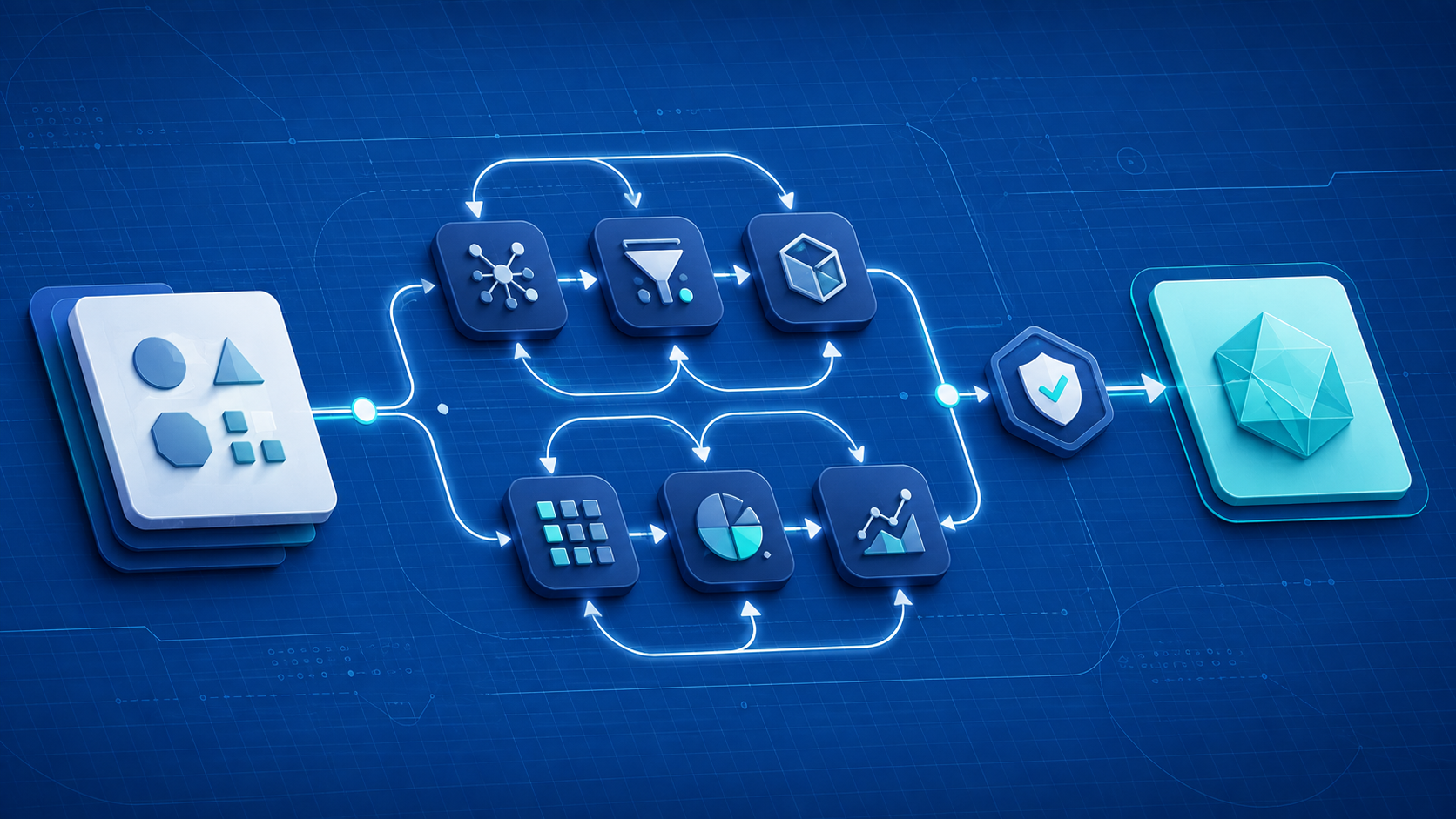
Gemini 3.8 Flash arrived on 2 September with a useful proposition for teams building agents: Google says its new general-availability workhorse can take on longer software-engineering and multi-step jobs while keeping the introductory API price of its predecessor. Meta released Muse Spark 1.3 the same day, making this less a single-model story than a sharper contest over how agents should behave when the work gets messy.
The big signal: Gemini 3.8 Flash
The headline is not simply that Gemini 3.8 Flash is stronger. Google is positioning it as a production model for long-horizon software engineering, autonomous agents and demanding enterprise workflows, rather than a cheap model that only handles a single turn well. Its developer documentation says the model is generally available, supports a one-million-token context window and up to 64,000 output tokens, and exposes low, medium and high thinking levels.
That control matters. Google explicitly says Gemini 3.8 Flash may use more tokens on difficult, long-running tasks because it takes smaller reasoning steps, calls tools iteratively and verifies work along the way. Teams can turn the thinking level down for latency-sensitive work, or stay on 3.7 Flash when efficiency is the actual requirement. That is a more useful product decision than treating every agent request as a maximum-reasoning problem.
The pricing signal is equally clear: Google lists an introductory rate of $0.75 per million input tokens and $3.75 per million output tokens through 31 December 2026. The standard rate is scheduled to double on 1 January 2027. A low unit price is not the same as a low task price if a model performs repeated tool loops, so builders should measure completed-work cost, failure rate and human review time together.
Google also shipped Gemini 3.8 Flash Cyber, a specialised variant for vulnerability discovery and automated patching. It is not a broadly available developer model: Google says access is limited to trusted defenders through its Fairwind Program. The constraint is part of the story. A capable agent can be valuable without being universally deployable, especially where the same skills can create risk.
Muse Spark 1.3: collaboration is the product
Meta’s same-day release makes the comparison more interesting. Muse Spark 1.3 is available in Muse Code and the Meta Model API, and Meta frames the upgrade around long-running agentic work, coding and better collaboration with the user. Its stated behaviours are familiar to anyone who has watched an agent go confidently wrong: ask clarifying questions when a prompt is ambiguous, ask for help when stuck, and confirm before consequential actions.
Meta also reports that, compared with Muse Spark 1.2, its engineers saw roughly 20% fewer tool calls and 25% fewer tokens in common engineering workflows. That is a vendor claim, not an independent guarantee, but it points at the right evaluation question. The useful agent is not the one that appears busiest. It is the one that reaches a checkable outcome with fewer unnecessary moves and knows when it needs a person.
For teams following the agent race, these launches move the conversation away from “can the model call tools?” and toward “can the system make progress without silently changing the brief?” That aligns with the verification-loop questions in our recent look at Google Antigravity Boost, and with the access-boundary lesson in Claude Fable 5.1.
Open-source watch
The Hugging Face trending scan was crowded: GLM-5.3, Qwen3.8 variants, DeepSeek-V4-Flash-Vision-Exp and LTX-2.5 were all drawing attention. None displaced the two same-day frontier releases as the lead news story, and trend position alone is not proof of a fresh launch. Still, the list is a reminder that model choice is widening at both the hosted and open-weight edges.
- GLM-5.3 and Qwen3.8: worth watching where teams want a second supplier, a self-hosted path or a workload-specific benchmark candidate.
- DeepSeek-V4-Flash-Vision-Exp: relevant for products that need visual input, but experimental vision models deserve task-specific testing before they reach a customer workflow.
- LTX-2.5: a separate video-generation signal, useful for creative pipelines but not a substitute for reliable text-and-tool orchestration.
What builders should take from this
For meLink, the practical implication is not to swap the brain behind every workflow because a leaderboard moved. Website assistants, orchestration surfaces and personal coordination tools need model routing that reflects the job: a quick visitor answer is different from a research task, a document transformation or a proposed account action.
Gemini 3.8 Flash makes a credible case for a “reason more, verify more” lane. Muse Spark 1.3 makes a credible case for agents that surface ambiguity and request human help rather than bluffing. Both approaches only become useful inside a product that preserves customer context, limits permissions, shows what happened and gives people a clean way to intervene.
Do not buy an agent on its best demo. Buy the operating model around it: scope, evidence, approval and recovery.
The practical takeaway
Test Gemini 3.8 Flash and Muse Spark 1.3 on one bounded, real workflow before making a platform decision. Give each the same inputs, tools, policy constraints and reviewer. Track completion quality, tool calls, total tokens, time to a reviewable result, and whether the agent surfaced uncertainty at the right moment.
The winning model will vary by task. The durable advantage is a system that can choose a model deliberately, keep sensitive context under control, and make the final decision legible to a human. That is what turns a fresh model release into a responsible capability upgrade.


Leave a Reply