
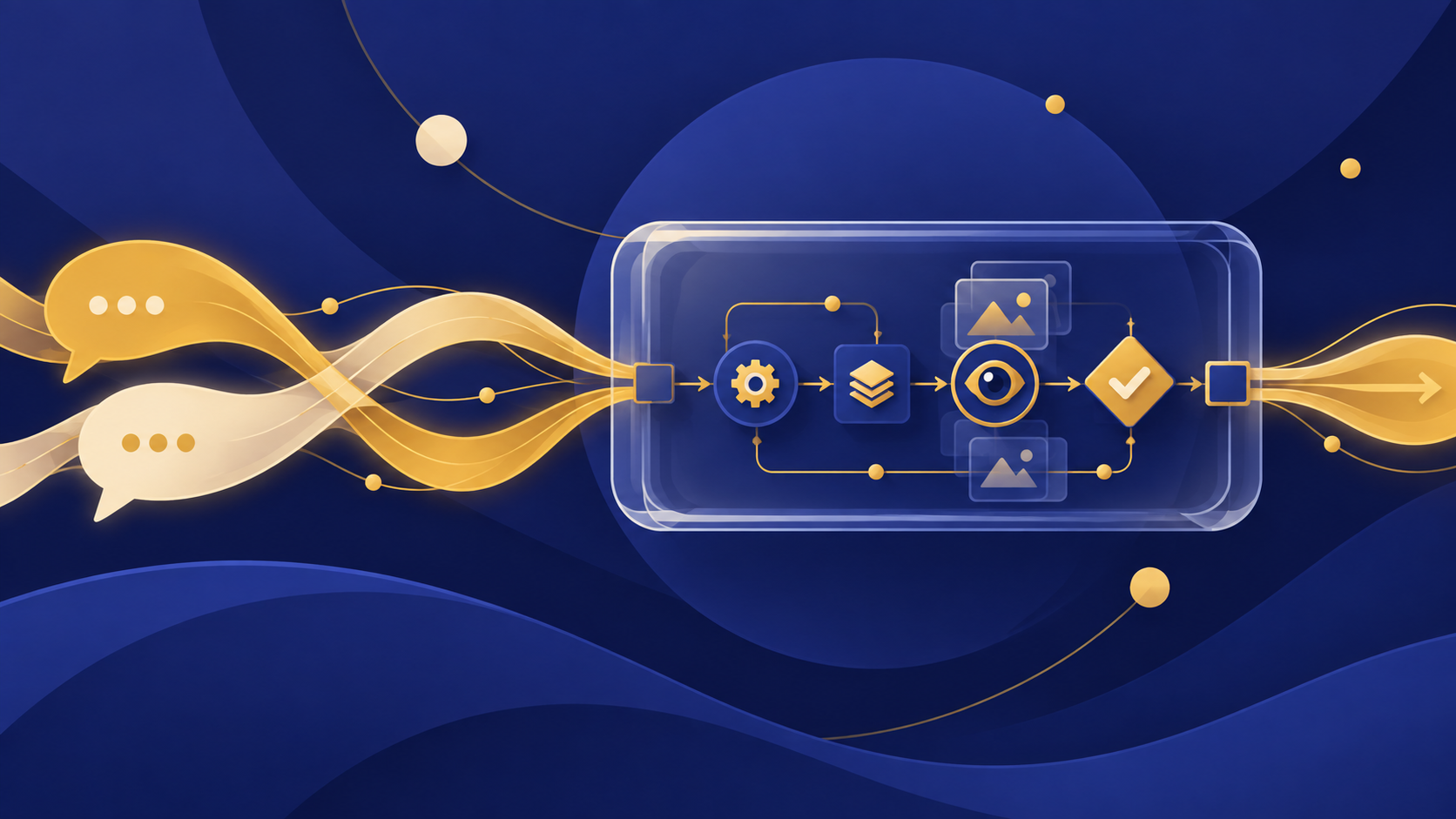
Gemini 3.8 Live is Google’s new live-dialogue model family, built to keep a conversation moving while it reasons, uses visual context and runs tools in the background. That is a meaningful shift for anyone building assistants: the interface no longer has to go quiet simply because the system has started doing work.
The big signal
Most voice and multimodal assistants still expose an awkward seam: listen, stop, think, act, then come back. Google’s Gemini 3.8 Live announcement describes a different operating model. The base model is designed for natural dialogue and near-real-time visual input; the Extended Thinking variant adds more deliberate reasoning when a request deserves it. Google says the models can execute tools and API calls in the background while the conversation continues.
The important claim is not that a model can call a tool. That has been possible for some time. The important claim is that the assistant can acknowledge the request, maintain the human exchange and return useful progress while the slower operation finishes. A customer asking for a comparison, a booking change or a product check should not have to interpret dead air as failure.
Gemini 3.8 Live changes the handoff
Google says Gemini 3.8 Live also processes visual input in near real time and can transition between 97 supported languages during a conversation. Those capabilities matter together. A practical assistant may need to see what a customer is pointing at, clarify intent in the same exchange, retrieve an answer and surface the one decision that needs a person. The system’s job is not merely to produce fluent audio; it is to make the handoff legible.
That is where product teams should stay cautious. Continuous conversation can make hidden work feel deceptively simple. If an action changes a booking, spends money, touches private records or sends a customer-facing message, the assistant needs an explicit boundary: what it is checking, what it is doing, what is pending and when it needs approval. The lesson aligns with our recent case for AI fallback policies: a smooth interface is useful only when it has a safe route for uncertainty and failure.
Open-source watch
The release lands in a market where teams are increasingly mixing hosted frontier models with smaller and open-weight components. Hugging Face’s trending list continues to feature DeepSeek-V4.1-Flash, Qwen3.8-27B, Edge0-35B-A3B-preview, MiniCPM5-2B and LTX-2.5. They serve different jobs, but the pattern is consistent: builders want options for latency, cost, modality and deployment control rather than a single universal model.
For agent builders, that makes routing and memory design more important than brand loyalty. A local or open model can handle a constrained classification, retrieval or privacy-sensitive task; a live frontier model can own the rich, high-context conversation. Our look at DeepSeek V4.1 Flash and agent memory costs is a useful companion: cheaper context changes which parts of an agent can stay available, but it does not remove the need to decide what should be remembered.
There is also a governance benefit in keeping those layers distinct. When a customer-facing assistant uses a fast live model for dialogue and a separate service for a sensitive operation, teams can set different retention, audit and permission rules for each. That is a more credible privacy posture than treating every interaction as an undifferentiated prompt.
Why this matters for meLink
For meLink web, the useful interpretation of Gemini 3.8 Live is not “put a voice model on every site.” It is the design pattern behind it: cover the conversation, do bounded work in the background and make escalation clear. A website visitor wants an answer now; a business owner wants confidence that the agent will not invent policy, reveal private data or silently commit an irreversible action.
For meLink avo, the same pattern is orchestration. A visual flow should show which task is active, which tool is running, which result is provisional and where a human gate belongs. Gemini 3.8 Live makes the conversational surface feel more continuous; orchestration still determines whether that continuity is trustworthy.
The practical takeaway
Gemini 3.8 Live is worth watching because it reframes the assistant from a turn-taking chatbot into an interface for work in progress. Test that idea with one real journey, not a generic demo. Pick a request that requires a tool call, decide what the assistant may say while it waits, define a timeout and fallback, and identify the exact moment a human must approve.
If the conversation stays clear when the tool is slow, unavailable or uncertain, the model is helping. If the smoothness hides those conditions, the experience is only more polished confusion. That distinction will matter more as live dialogue, vision and background agents converge.


Leave a Reply